
The 486 CPU Era – The Birth of Overclocking. – Part 2
In Part 1 of The 486 CPU Era – The Birth of Overclocking, we covered some of the basics of the 486 era and where it came from, as well as the various brands/types of 486s of the era (many of which we will test and attempt to overclock. In Part 2 we will discuss the hardware selection and rational, testing environment and benchmarks! (and a healthy dose of Overclocking with some perhaps surprising results)
Choosing a Motherboard
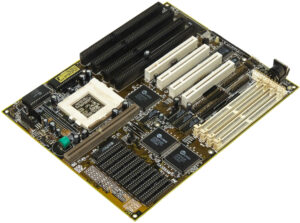
Socket 5, GIGABYTE GA586AM, UM8891BF / UM8892BF chipset – Good but not good enough
Choosing a motherboard for the 80486 platform is not easy. There are several criteria or approaches for the implementation of such projects. 1. Consider whether you need PCI slots? 2. The need for VLB slot(s) 3. The need for everything on one board.
Since I set myself the task of assembling the most productive Socket 3 system, the presence of ISA and VLB slots was a secondary matter for me, PCI slots were a priority due to their speed characteristics. The fastest chipset was required from the motherboard – this is the UMC 8886/8881. Revisions of this chipset were later used in Socket 5 Pentium motherboards that supported FSB 60/66 MHz and higher. The board must have 4 slots for RAM with support for EDO RAM, the minimum total size is 128 MB (4x 32 MB).
The total size of the L2 cache should be equal to 1 MB, so the motherboard should contain 8 sockets for such microcircuits.
Due to the use of different processors with different input voltages, the board must support a choice of voltages from 3.3 V to 5 V in small steps, in order to be able to “smooth” overclocking. Accordingly, the overclocking capability on the bus from 33 to 50 MHz and higher should be implemented. So which board do we end up with?
Posted in:
Boards and Systems