
August 13th, 2010 ~ by admin

The evolution of the Apple iPhone and its many CPU’s – Even within a model

The CPU Shack is pretty much on the trailing edge of technology, we are, after all, a museum.  However, we fancy the new technology as well, and like to crack it open for a look see.  The iPhone, in its 4th generation, is an oasis of CPU’s, sadly we have not been able to get one.  That has now changed….

Anthony, of the iPhone repair company Milliamp.com has graciously donated the logic boards from a iPhone 2G, 3G and 3GS. No 4G iPhones yet, but perhaps later.  Now there has been several teardowns of iPhones as they came out, notably by the good folks at iFixIt.  We are going to explore the many CPUs in each model of iPhone, the changes made as they evolved, and something new though not entirely unexpected.

CPUs by function and generation of iPhone:

Function 2G 3G 3GS 4
App Processor Samsung S3C6400 400-412MHz ARM1176JZ Samsung S3C6400 400-412MHz ARM1176JZ Samsung S5PC100 600MHZ ARM Cortex A8 Apple A4 800MHz ARM Cortex A8
Baseband S-GOLD2 ARM926EJ-S <200MHz Infineon X-Gold 608 ARM926 312MHz + ARM7TDMI-S Infineon X-Gold 608 ARM926 312MHz + ARM7TDMI-S X-Gold 618 ARM1176 416MHz
GPS NA Infineon HammerHead II Infineon  HammerHead II BCM4750 (no CPU core)
Bluetooth BlueCore XA-RISC BlueCore XA-RISC BCM4325 (2 CPU cores) BCM4329 (2 CPU cores)
Wifi Marvell 88W8686 Feroceon ARMv5 128MHz Marvell 88W8686 Feroceon ARMv5 128MHz see above see above
TouchScreen Multi-chip BCM5974 TI TI
OS Nucleus by Mentor Graphics Nucleus Nucleus ThreadX by ExpressLogic
Total Cores 5 7 7 5

Applications Processor vs Baseband Processor

On a device such as the iPhone it is common to have two separate CPUs that run the phone.  The Baseband Processor runs the underlying hardware of the phone (the radios, etc)  This is critical timing wise so it runs its own OS, a Real Time OS capable of dealing with all the complexities in making a phone call or sending data to a cell tower.

The Applications Processor runs just that, the applications, such as iTunes, and iOS itself, this way they are independent of the phone portion. This way if say the new game you installed crashes, it does not effect your phone talking to the tower.

In addition to the applications processor and baseband processor there are several others.  The GPS has its own processor, as does the Bluetooth, and the Wifi as well as the touchscreen. Some of these are pretty simple CPUs, but think back  a few years.  The CPU running JUST the wifi in an iPhone is faster then most desktop computers 15 years ago.
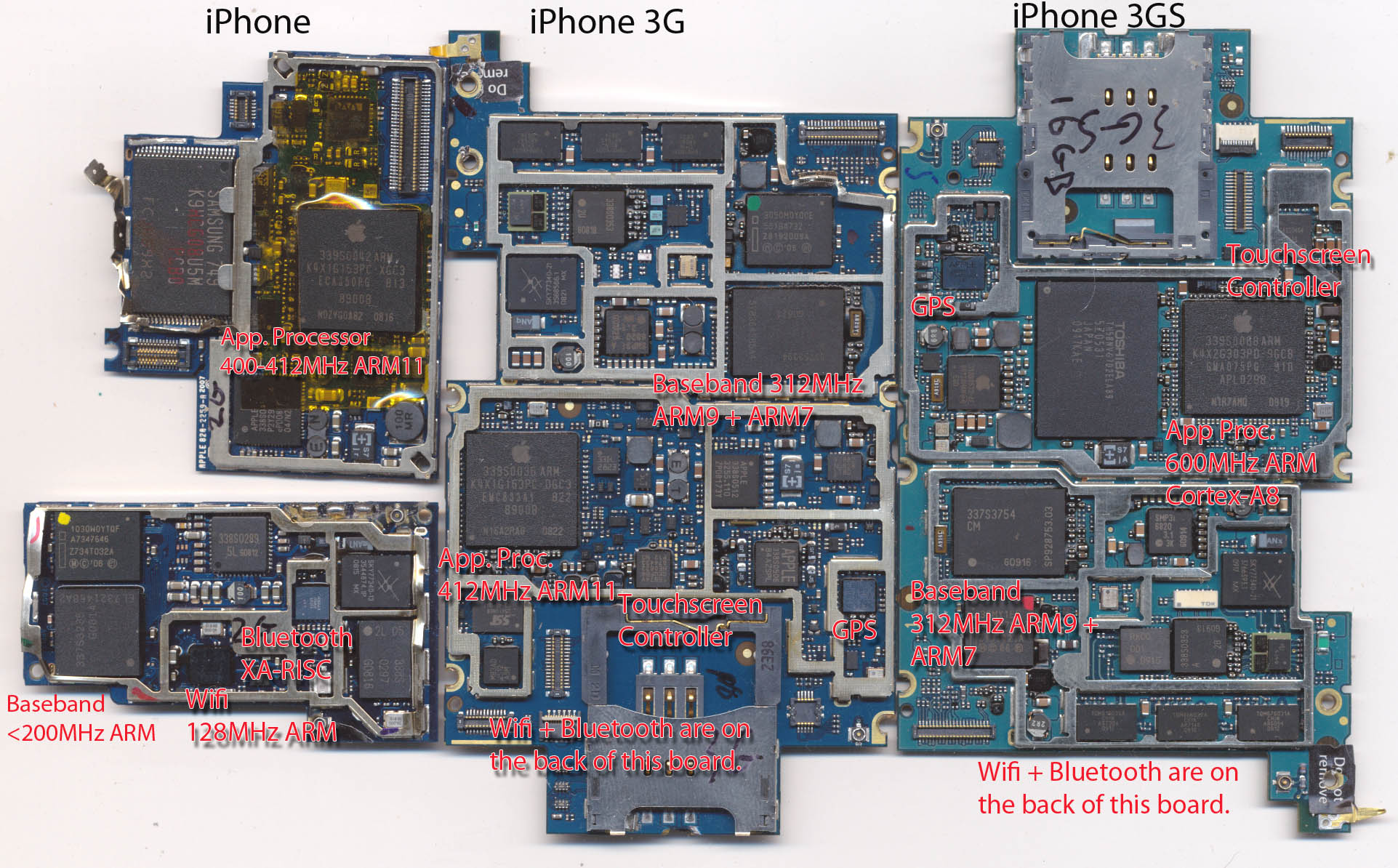


Apple iPhone Logic Boards

Apple iPhone 2G

The Original iPhone and the 3G used the same app. processor, an ARM11 based CPU made by Samsung. It initially ran at 400MHz but via a software update was bumped up to 412MHz.

The biggest change in the 2G to the 3G was the addition of GPS and a change in Baseband.  the 3Gs baseband ran at less then 200MHz, but the 3G runs at up to 312MHz, and included 2 actual ARM processors. add in the CPUs that runs the touch screen, GPS, wifi, and bluetooth and you scan see there is ALOT of processor power in the phone.  7 DIfferent CPUs just to make the phone work.

Apple iPhone 3GS

The 3GS iPhone boosted the speed of the applications processor considerably (and thus it runs iOS4 MUCH better then the 3G).  Again the app processor is made by Samsung, but now its clocked at 600MHz, and based on the ARM Cortex-A8, a faster core then the ARM11 design.  This processor will do 800+MHz but Apple underclocks it for the sake of battery life.  The baseband remains the same, but APple used an integrated chip to handle both the Bluetooth and the wifi.

Apple iPhone 4G

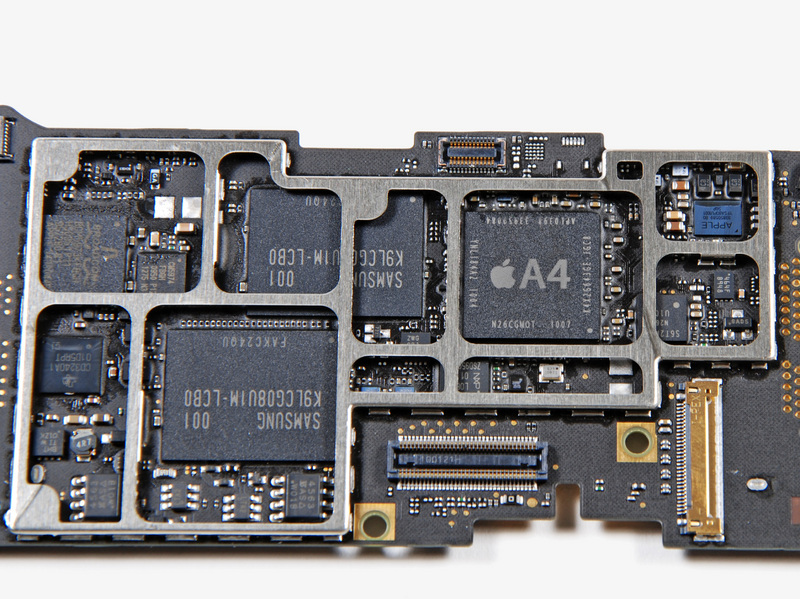
Previous models of iPhones carried something over from the previous model. Whether it was the app processor, baseband, or wifi, there was some reuse. Not so with the 4G, All the important bits are new.  The App processor is the same as in the iPad, the ARM Cortex-A8 based A4 (which really is a Samsung/Intrinsity design.  This design we know is capable of 1GHz (as it does such in the iPad, however, to preserve battery, its clocked at around 800MHz in the iPhone.  The Baseband processor is also all new, its now running a single ARM11 core at up to 416MHz.  The Baseband processor in the iPhone 4 is faster then the original CPU in the iPhone 3G. The Real Time OS that runs on the Baseband also changed, from Nucleos, to ThreadX. They are made by different companies (Mentor Graphics vs Express Logic) however the same designer wrote them both (William Lamie)

Apples mid-life CPU revisions

Its common for a design to evolve somewhat in the life of a product. This seems to have happened considerably within iPhone generations.

Device App Processor Part # Date Code
iPhone 339S0030 0722
iPhone 339S0042 0816
iPhone 3G 339S0036 0822
iPhone 3GS 339S0068 0919
iPhone 3GS 339S0073 0919
iPod Touch 1 339S0029 0731
iPod Touch 2 339S0048 0831
iPod Touch 3 339S0075 0928

Apple used several revisions of what SHOULD be the same CPU. the iPhone and iPhone 3G use the same processor, but here we see no less then 3 different part numbers for it.  In the 3GS we see something similar, even for devices dated the same week, there is 2 different part numbers.  Its curious what Apple/Samsung saw fit to change.  If you know of other part numbers, lets us know
Tags:
, ,

Posted in:
Research

June 8th, 2010 ~ by admin

Unlocking EPROM cores?

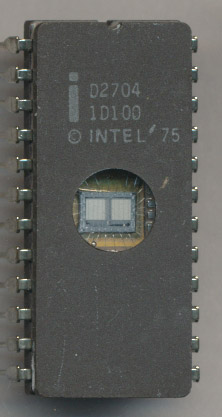
Its well known that manufacturers such as Intel and AMD will sell quad cores as dual cores, or 6-cores as quad-cores in order to meet demand, or to use dies that didn’t ‘make the cut.’ This process has been going on for over 30 years though. Back in the 70’s and 80’s it was very common for a device such as this:

Intel D2704 4k EPROM

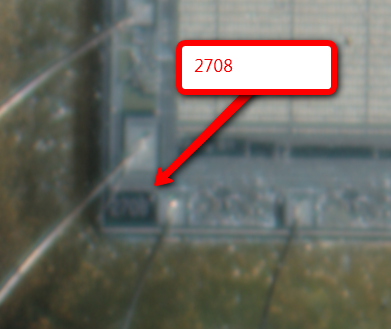
Which is a 2704 4k EPROM, to actually be made from a 2708 die, just with not all the leads connected, or sometimes, with them connected but just labeled as the smaller part. In a production environment, it is cheaper to have a single production line making dies that can be used in more then one device, then having an entire seperate production line just to make a product that may not be the most popular.  Look at this die shot (its a bit blurry) but you can see its a 2708 die.

2704 with 2708 die

Once again, whats new, really isn’t we have just went from small EPROMs, to CPUs with billions of transistors

May 14th, 2010 ~ by admin

A look at the CPU Shack….Boxes Boxes and more

I was out of town for a couple weeks visiting family. My friends were of course ‘taking care’ of The CPU Shack while I was gone. Upon my return I entered the Shack and this is what I found:

Yah thats over 100 boxes of CPUs that came in the 14 days I was gone, all stacked in the entrance to the rest of my house. Welcome to The Shack!

April 22nd, 2010 ~ by admin

Apple rumored to buy ARM Holdings

AppleInsider has a post up about a potential interest Apple has in ARM Holdings, designers of the ARM processor cores used in the iPod, iPhone, and iPad, among tens of thousands of other devices. Apple has a market cap, of almost $250 billion, while ARM is just shy of $2 billion. Apple clearly has the cash abilty to purchase ARM outright, and they certainly have a reason to want to.

However, the rest of the computer world has an even bigger reason to keep Apple from doing so.  ARM devices are used by tens of thousands of devices, made by thousands of companies. Silicon containing ARM IP is made by hundreds of companies across the world. The success of these companies, their designs, and the devices they power is in large part based on fair, equal, and predictable availability of licenses from ARM.

If Apple were to own ARM, they could completely stop the availability of licenses to any design they felt was a competitor, or they could delay the release to third parties of newer designs. This is similar to the problem some phone companies are experiencing with Google and their Android OS, Google is motivated to sell their own branded Nexus One phone, with the latest version of Android, before giving the same version to third parties.

Read More »

April 11th, 2010 ~ by admin

Prayers for the People of Poland

A rather large tragedy and loss. The CPU Shack sends its sympathy to the CPU collectors, and entire country of Poland for their loss. May God be with you all.

Posted in:
Uncategorized

April 9th, 2010 ~ by admin

Cyrix MediaGX: From Cyrix to AMD – A bit a History

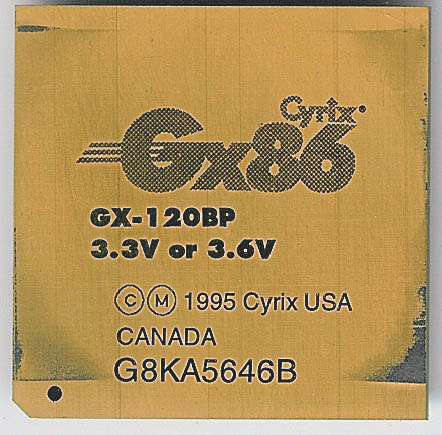
On February 20th of 1997 Cyrix announced the MediaGX processor, running at speeds of 120 and 133MHz. By June of that year they were up to 180MHz as production was ramped at National and IBM (see press release). These processors were based on the Cyrix M1 (5×86) architecture and integrated basic graphics, and audio functions. They were sold as a ‘PC on a chip’ for budget applications, with a bit of a budget performance.

Early MediaGX Marked Gx86 120MHz circa late '96

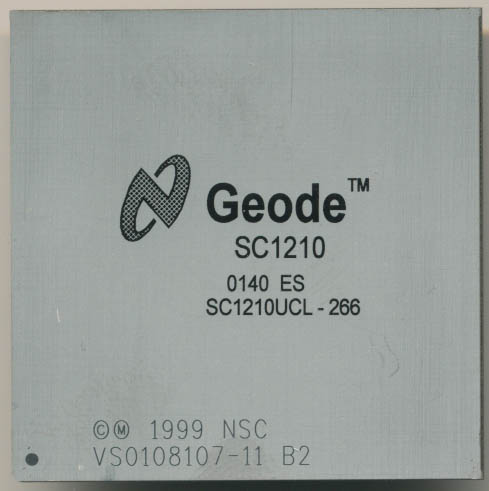
In October 1997 Cyrix announced plans for the Cayenne cored MXi, a follow on to the MediaGX. By 1999 National Semiconductor had made some samples of it, but thats as far as it got. This was also when National Semiconductor bought Cyrix, effectively ending Intel’s lawsuit against Cyrix over x86 licensing as National held an x86 license. The Media GX was bumped to 200 and 233MHz and MMX support was added.

National Semiconductor Geode 266MHz circa 2001 Sample

Read More »

April 5th, 2010 ~ by admin

Apple iPad Round up: Inside and Out The Processors of Apple’s Latest

Apple Officially has launched the iPad, essentially a scaled up iPhone, and judging by the model number, it started development several years ago around the time of the first iPod Touch. Many of the components are similar to the iPhone, if not the same. Obviously the biggest processor ews is the Apple A4 ARM processor at its heart. Its developed by Apple, and built by Samsung. a multi-die package, it includes the ARM processor, and PowerVR Graphics on one die, and then two 128MB DRAM dies as well.

iPad Motherboard - A4 CPU by Samsung

What is interesting about the A4? It has a 64bit memory bus, rather then the more standard 32bit but found on most ARM devices. This likely for faster memory access to support faster graphics.

Wifi, Bluetooth, and FM functions are handled by a Broadcom BCM4329 which includes two processors of its own (the documentation of this part does not state what architecture they are, but MIPS or XA-RISC is likely)

The screen controller is the Broadcom BCM5973/5974 which has been used by Apple for several years. The Baseband processor in the 3G version is the Infineon X-Gold 608 which contains a 312MHz ARM926 processor, a 2007 design, so probably saved Apple some money.

So all told the iPad 3G contains at least 4 seperate processors.

Instrinsity: ARM Processor Design House

In related news rumors are flying about Apple acquiring Intrinsity. Instrinsity is a processor design house which specializes in, you guessed it, ARM processors. Its likely they have helped Apple more on the A4 then P.A. Semi (another Apple acquisition) This is further supported by the fact that Intrinsity has worked a lot lately with Samsung in developing a 1GHz ARM CPU (the Hummingbird). Who fab’s the A4? Yah, Samsung.

Sources:
EE Times: Inside the iPad
EE TImes: Inside the iPad: Broadcom/Samsung
iFixit: Teardown
ars technica: Apple buys Instrinsity

April 1st, 2010 ~ by admin

AMD Launches ‘Lottery-Core’ CPUs

AMD today unvelied their new CPUs for gamers, which seem to readily appeal to poker players. The New Lottery Core series contains 12 cores. However, as is normal with production of such a complex device some, or all of these cores may not work.  AMD has designed the cores/CPU such that if a core fails, the others will function fine, this of course saves them testing, as well as packaging costs as each chip can use the same package and markings.

Obviously these are targeted specifically for the hobbiest, and priced accordingly. You may get one with all 12 cores functioning and if so AMD considers you ‘very lucky’ apparently not so much if you get one with no working cores.

Currently these are only available in the UK, but if successful should spread elsewhere.

More Info at PC Pro UK

Tags:

Posted in:
Processor News

March 31st, 2010 ~ by admin

The Origin of ARM – New Finds for the Museum

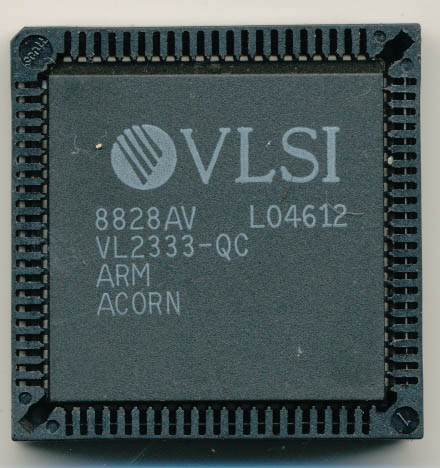
I’ve posted a fair amount about ARM processors, as today, they are in about everything. That was not always the case. ARM began with a small British company called Acorn Computers, who made various computers such as the BBC Micro (6502 based). They began developing a RISC processor in 1983 with their silicon partner VLSI. We recently received a few early versions of the ARM so here they are, with a brief history.

VLSI VL2333-QC 8MHz ARM1 CPU circa 1988

By 1985 they had the first working silicon of the ARM1 processor, a full 32bit design. It had around 25,000 transistors (compared with the earlier Motorola 68000 which had 70,000) so was relatively cheaper.

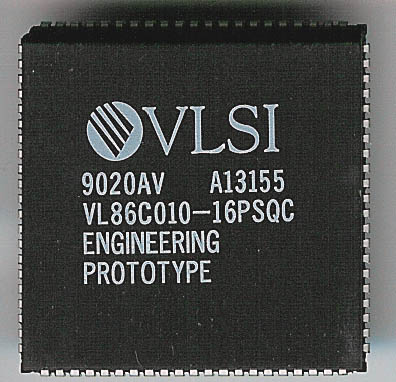
VLSI VL86C010-16PSQC 16MHz ARM2 CPU

VLSI VL86C010-16PSQC 16MHz ARM2 CPU circa 1990 - Prototype

The next year the released the ARM2 processor, which added a hardware multiply instruction and ran at 8MHz. It had around 30,000 transistors.

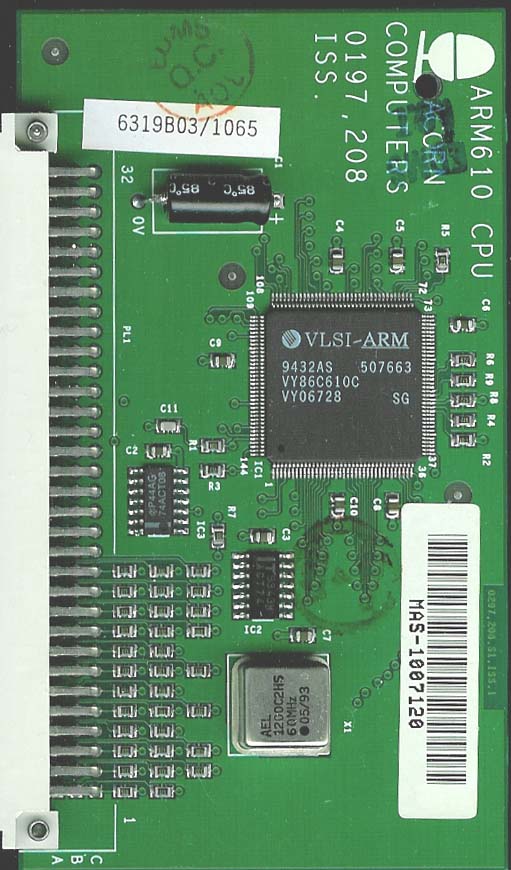
VLSI VY86C610C 30MHz ARM610 CPU circa 1994

VLSI VY86C610C 30MHz ARM610 CPU circa 1994

In 1994 the ARM6 was released with higher clocks (up to 60MHz) and more features.  The rest as we say is history, with many many varieties of cores available, at speeds over 1GHz, but STILL very small footprints. The ARM cores are licenses to hundreds of companies worldwide, and used in millions of devices, and it all began almost 30 years ago.

Tags:
, ,

March 26th, 2010 ~ by admin

The processors of the Internet – Keeping the data flowing

Routing internet traffic takes a vast amount of processing power. Gone are the days of dialup, where data could be processed with relative ease. Now with every connection pumping out data at rates measured in Mbits, high end devices are needed to route, inspect, and shape that traffic. These devices literally inspect, and operate on EVERY packet that goes through them, that require incredible speed to do so without affecting the speed of the data.

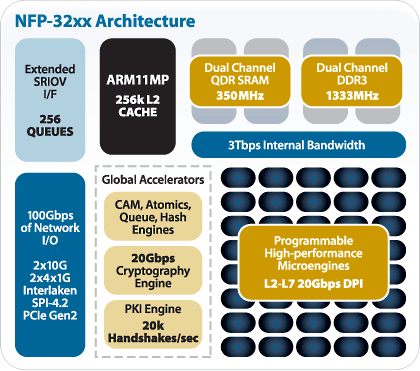
Netronome NFP-32xx block diagram

Enter such companies as Netronome, a maker of network flow processors, compatible with the Intel IXP28xx series. Each one of these processors has a 700MHz ARM CPU, as well as 8 1.4GHz RISC based Microengines are capable of delivering 56700MIPS. Expect to see more such products as companies work to meet President Obama’s National Broadband Plan.