October 15th, 2010 ~ by admin

Zilog: The First Decade: Z80, Z8 and the Z8000

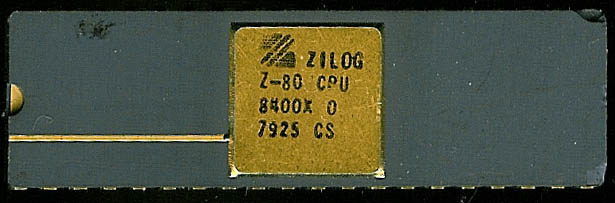
In 1974 Federico Faggin left Intel after working on the 8-bit 8080 processor.  He formed a company called ZiLOG and developed a much improved version of the 8080 called the Z80.  It was released in 1976 after only 18 months of design.  The Z80 was faster, cheaper, and simpler to build around then the 8080 and enjoyed extremely wide use.  ZiLOG designed the CPU but it was marketed differently than most at the time.  Any company could purchase a license to the design, and build them royalty free.  They were also free to do with the design as they pleased.  This resulted in dozens of companies making clones/versions of it. The Soviets made unlicensed copies as well. In fact other companies made more Z80s then ZiLOG did themselves.

Zilog Z-80 CPU 8400X CS – 1979 2.5MHz

The Z80 was not the only processor that ZiLOG made.  Some of the processors/part numbering can be a bit confusing so we’ll look at each family and part that Zilog made up through 1985.  After 1985 CMOS designs came out as well as dozens of variations.  We just want to look at the first ten years of ZiLOG.

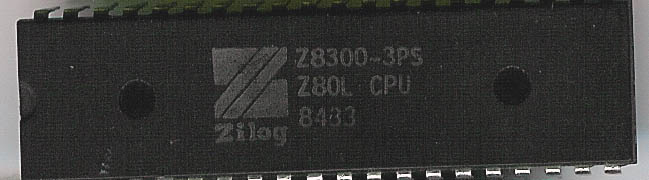
Zilog Z8300-3PS – 1984 2.5MHz

The Z80 itself was, of course, similar to the 8080 but single voltage, and only required a single clock phase.  It was available in speeds of 2.5-8MHz.  ZiLOG also made a low-power version known as the Z80L (Z8300) that ran from 1-2.5MHz.  That’s really all there was to the Z80 family up through 1985.

Read More »

Tags:
, , ,

Posted in:
Research

October 11th, 2010 ~ by admin

Soviet Beauties: Processors from behind the Iron Curtain

The Soviet Union’s electronic programs were mainly focused on copying and cloning Western devices.  Either by simple theft, or painstaking reverse engineering.  They made clones of devices such as the Intel 8080, and the AMD 2901 as well as simple TTL.  The Soviets also made many single and multi-chip versions of the venerable DEC PDP-11 computer system.  Many of these have no Western analogs, they were pure creations of the Soviet industry.

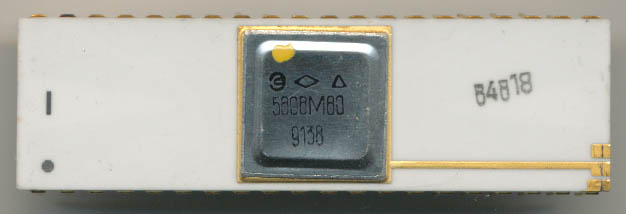
Soviet Kvantor 580VM80 - Intel 8080 - Milspec

While Western chips rapidly transitioned into mostly black plastic by the 1980s the Soviets did not.  The 8080 above was made in 1991 though looks like something from the 70’s. Black plastic is cheap, and easy to make, but it isn’t great looking. The Soviets on the other hand made some of the best looking (if not always functioning) processors of the time.

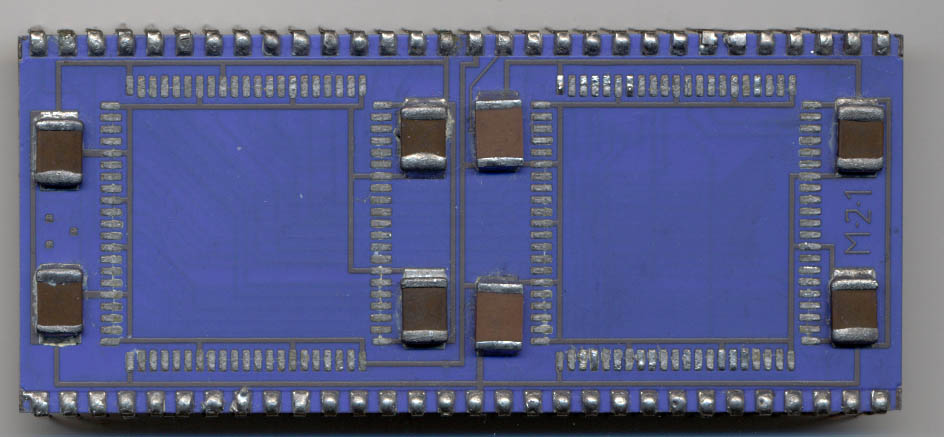
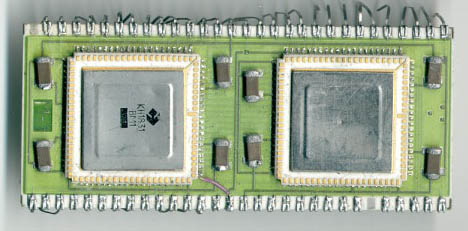
Soviet J-11 Missing the chips

Here is just the substrate (its a non finished example) of a Soviet clone of the DEC J-11 CPU. Not often do you see a brilliant blue processor.

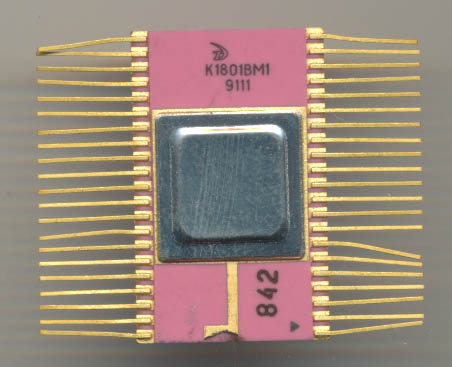
Soviet Angstrem K1801VM1

This is a nice pink ceramic Soviet PDP-11 5MHz CPU. Again this was made in 1991.  Its a form of surface mount package that was used extensively for industrial and military designs.  Just as the PDP-11 was used by the American military throughout the 70’s and 80’s. the Soviets used it (and now Russians) in todays times.

Soviet era CPUs are very interesting to collect.  Each state run factory had their own logo which was typically (but not always) put on the chip. Many part numbers were made by more then one factory. Most chips have a western analog, but not all.  Soviet chips also were ever so slightly different sized then Western ones. The Soviets used a pin spacing of 2.5mm where as the West used 0.1″ (2.54″), rather noticeable on a 40 pin DIP. Reading/translating some of the Cyrillic  based characters can be a chore but really when you get to see things like this…

Electronika J-11 - Image courtesy of iguana_kiev

Can you really complain?

October 7th, 2010 ~ by admin

The Rise of the Vortex86: Embedded x86 Processors

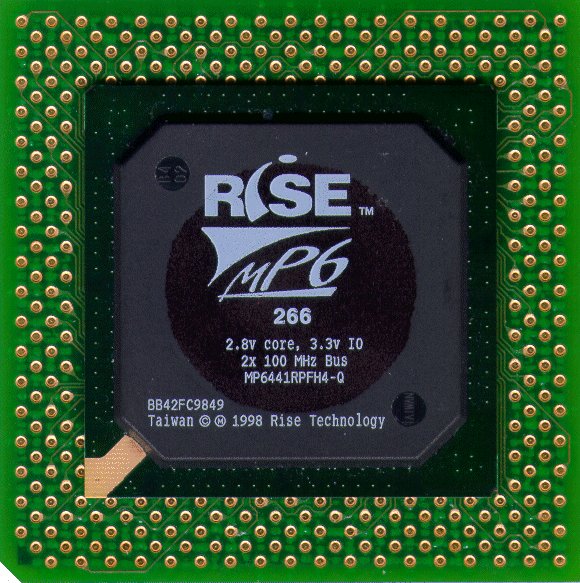
Back in 1998 a fabless CPU company introduced the Rise mP6 x86 CPU running at 166MHz Later versions ran at up to 233MHz and were Performance Rated at a somewhat generous PR300.  Rise was a bit late to the party of desktop x86 designs, and had somewhat lackluster performance.  In the 90s they had to compete with Intel, AMD, IDT, and IBM/Cyrix.  VIA, who later bought IDTs Centaur (Winchip) division, as well as Cyrix from National Semiconductor was an investor in Rise, as they were wanting an entry into the CPU market as well.  The mP6 used 16K of L1 cache and an 8 stage pipeline capable of executing 3 integer instructions per clock cycle.  This at a time when most CPUs had 32K or even 64K of L1 cache, and better branch prediction crippled the mP6.  It was used in set-top boxes and other low power type applications.  Rise licensed the core to ST Microelectronics who used it in set-top SoCs.
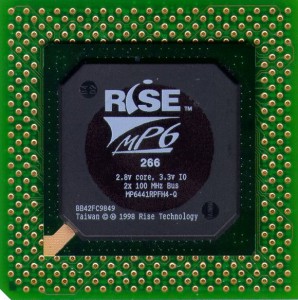
1998 Production Rise mP6 200MHz

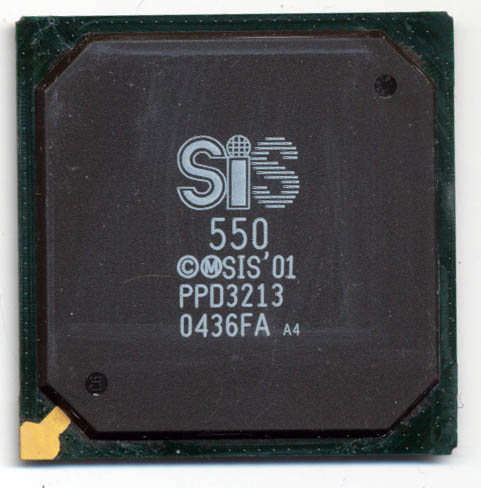
By 1999 Rise was losing money and losing sales.  In most areas this would have been the end, Rise would be a foot note in history (a smaller one then they are).  However SiS, known for their value chipsets and budget graphics cores, bought what remained of Rise and the mP6 core.  SiS wanted to develop an embedded CPU out of the mP6, and having a lack of experience took a while to make it happen.  In late 2001 they had what they wanted. The SiS 550 was at its core a 200MHz mP6 but now integrated audio, video and IDE controller all at 2/3 the power requirements of the original.
2004 Production 200MHz SiS550 CPU

The SiS550 found a home in several Thin Clients made by Neoware as well as various internet appliances.
We wrote about the SiS550 series many years ago here.

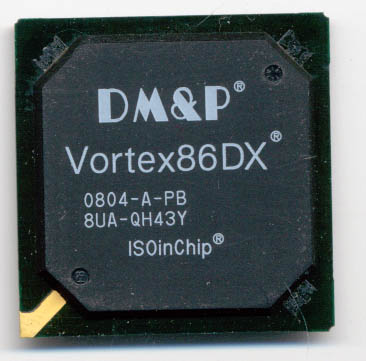
DM&P (aka Jan Yin Chan Electronics) eventually took over the design from SiS.  It is DM&P who took the lowly mP6 design into the powerful embedded CPU it is today.  The pipeline was reduced to 6 stages, and onboard 256k L2 cache was added.  The L1 cache was doubled to 32K, and the clock speed was increased to a rather quick 1GHz.

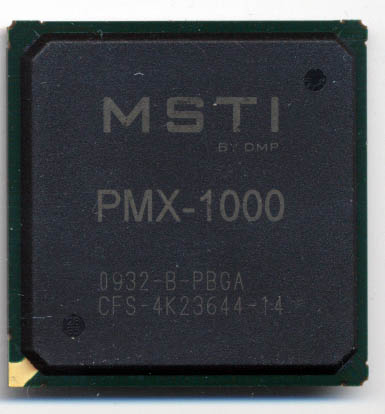
The Vortex86DX is a fully capable x86 processor.  It is perfect for very small PC applications and embedded designs where x86 code is required.  The PMX-1000 can run at up to 1GHz and adds IDE support, graphics, and HD-Audio (much like the original SiS550.
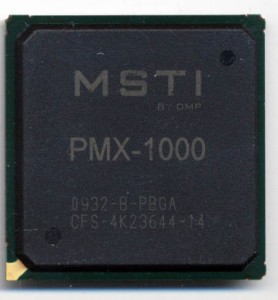
1GHz PMX-1000 - 2009

While technically an embedded CPU the PMX-1000 is fully capable of running Windows and other x86 programs.  eBox (part of DM&P) makes many small form factor, fanless, and sealed PCs based on it. It runs on a rather small 2.2Watts at 800MHz, a third the power, and 4 times the speed of the original Rise mP6.
DM&P Vortex86DX

Processor Date MHz Pipelines L1 L2 Process Watts
mP6 1998 200 8 16K 0.25u 7
SiS 550

Vortex86

2001 200 8 16K 0.18u 4
Vortex86SX 2007 300 6 32K 0.13u 1
Vortex86DX

Vortex86MX

2008 1000 6 32K 256K 0.09u 2

The original Rise mP6 design is going on 12 years old and is still in wide use.  While most CPUs have switched to a RISC like design internally. the mP6, and its Vortex86 variants retain the in-order CISC architecture of the 1990’s, and for what it does, thats just fine.  Thanks to DMP Electronics for donating the Vortex86DX and PMX-1000!

Tags:
, ,

Posted in:
Research

September 27th, 2010 ~ by admin

Original Models: A Look at Iconic Tech Prototypes

Wired has an interesting article about several prototypes of rather historical devices.  Of much interest are the Apple 1, and the Atari 2600 although the doorbell powered Moog is pretty classy as well.

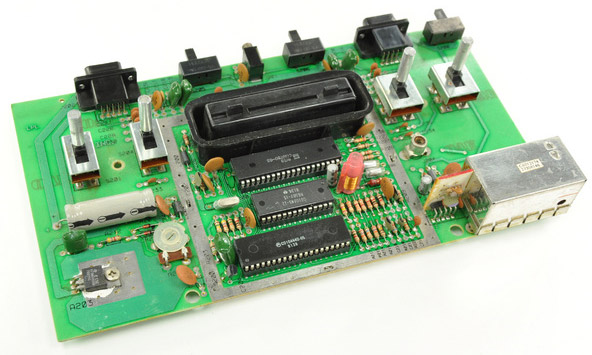
Take a look at the Atari 2600 prototype and notice that they used a MOS 6502 in it.  The final version used the lower cost (and smaller) MOS (or Synertek) 6507.

Atari 2600 Motherboard - 6507 CPU

When designing a product, it often is easier to use the standard full featured version of an IC for development work, and then as you refine the design, trim down to the least, and smallest components you can.

We also learn how Foxconn got its idea of low wages.  Steve Jobs himself paid his sister a mere $1/board to assemble the Apple 1.

Its interesting to see how prototypes can be so vastly different from the finished product.  A fact that design engineers know all to well. “I have to put all of THAT into what?”

Tags:
, ,

Posted in:
Just For Fun

September 23rd, 2010 ~ by admin

Arithmetic Processors: Then and Now

In the beginning there was the microprocessor.  A collection of logic that centered around an ALU (Arithmetic and Logic Unit) and a series of registers.  It was capable of doing most tasks just fine.  Simple math, and boolean logic were the key to most programming needs.  As the life of the processor and its extension, the microcontroller, progressed the computing needs became larger.  Programmers wanted to be able to manipulate larger numbers, and floating point ones at that.  Add and Subtract were no longer sufficient, division, multiplication and a host of other mathematical functions were needed.  In the 1970’s transistor counts were in the thousands, frequency in the MHz and line widths were measured in microns.  It was not feasible to build these math functions, in hardware, on the same chip (or rather die) as the processor.

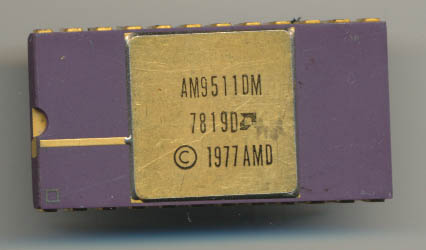
AMD AM9511DM – 2MHz Military Temp Range APU – 1978

Several companies worked to solve this.  Perhaps the most successful, and famous, was AMD.  AMD in 1977 introduced the AM9511 Arithmetic Processing Unit.  It is best described as a scientific calculator on a chip. It could handle 32 bit double precision math (via 16 bit stack/registers) and supported not just the basic ADD, SUB, MUL and DIV, but SIN, COS, TAN, ASIN, ACOS, ATAN, LOG, LN, EXP, and PWR. 14 floating point instructions, in hardware, on a single chip.  It ran at up to 3MHz (4MHz in the ‘A’ version) and could interface with pretty much any microprocessor or microcontroller, providing much needed processing power.  It was designed as a peripheral, so that the main processor could assign it a task, and then go on about its program while the AM9511 crunched the math.  The AM9511 would then notify the host processor via interrupt that it was finished the the data/status was ready to be read.

AMD updated the design to support……

Read More »

September 20th, 2010 ~ by admin

Visual Transistor-level Simulation of the 6502 CPU

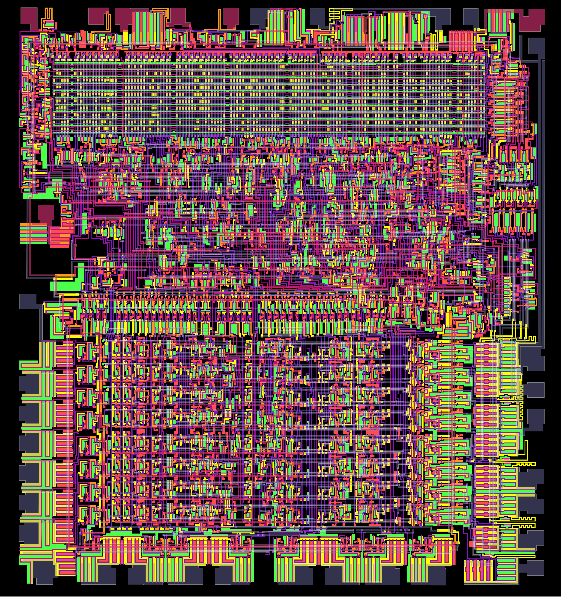
Here is an interesting project.  Take very high resolution photography of a MOS 6502 die (such as that the powered the Apple 1) and use it to construct a simulater in Java that allows you to program the 6502 and watch it, on a transistor level, as it performs the program.

6502 Die - Visual 6502

An awesome way to see PHYSICALLY what happens for each and every instruction.  And what a great processor to do so on.  Ironically the LCD flat panel monitor you may be using? It may well be powered by a 6502 (Novatek used them in their flat panel controllers)

Check it out at Visual 6502

Tags:

Posted in:
Just For Fun, Research

September 15th, 2010 ~ by admin

Homebrew Cray-1A – 1976 vs 2010

In 1976 the fasted normal processor ran at around 5MHz (such as the RCA 1802).  Personal computers really hadn’t been thought of, and mainframes were massive.  It was then that Seymour Cray decided to build a Super Computer. A computer that would be better and faster then most anything that existed at the time.

The Cray-1 ran at a blistering 80MHz, and could work with a staggering 32MB of memory.  This performance was not achieved in personal computers until the 1990’s.  No single processor of 1976 could attain these speeds so Cray designed his own.  Only 4 different types of ICs were used in the Cray-1 (2 types of quad-NAND gates and 2 types of SRAM)  All of the logic was ECL (Emitter Coupled Logic) which was very fast, very power hungry, and produced a lot of heat.  In all the Cray-1 used some 200,000 gates, many of which were solely used to add timing delays to make sure signaling did not generate standing waves or switching noise.

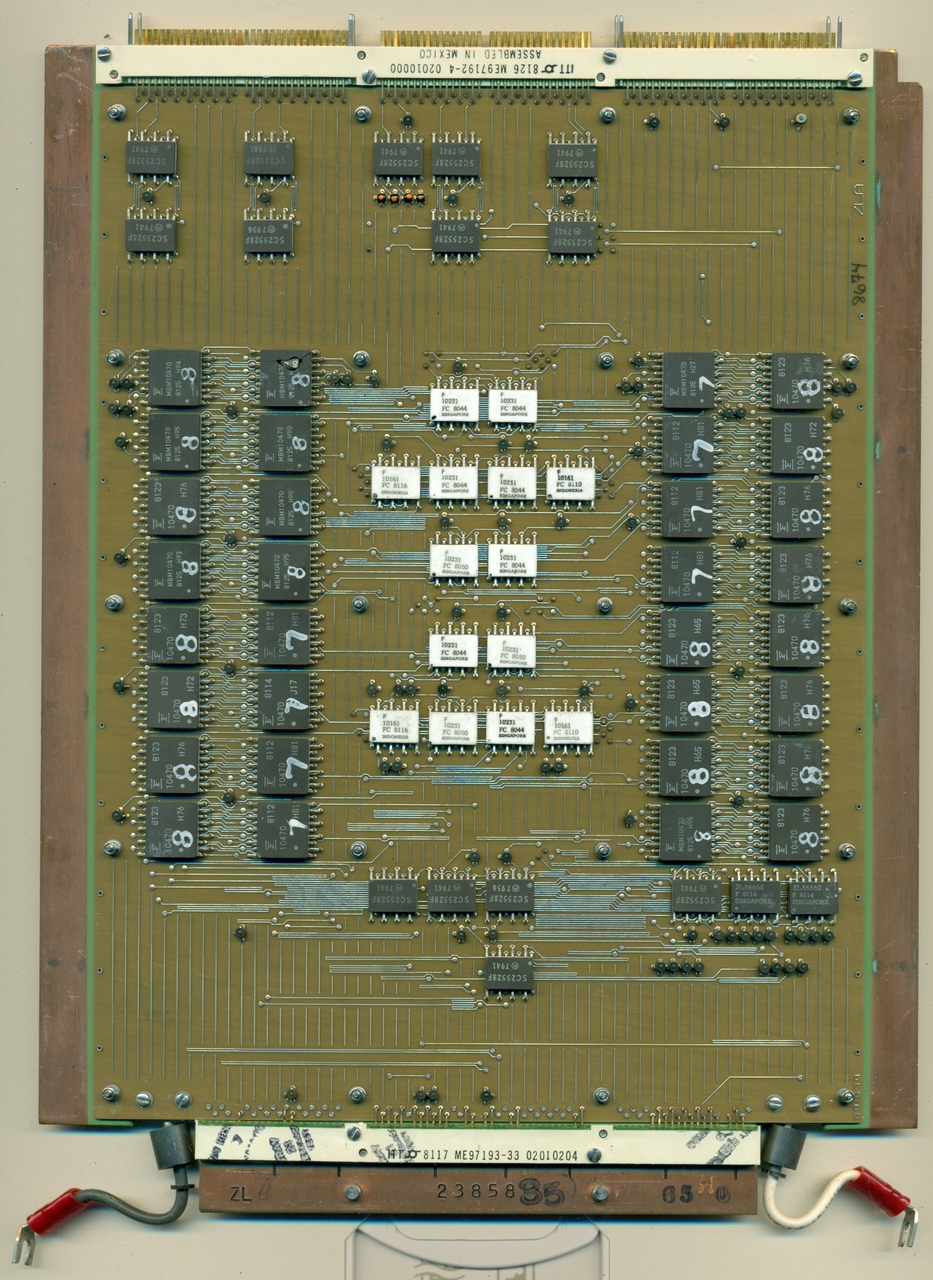
Original Cray-1 Circuit Board

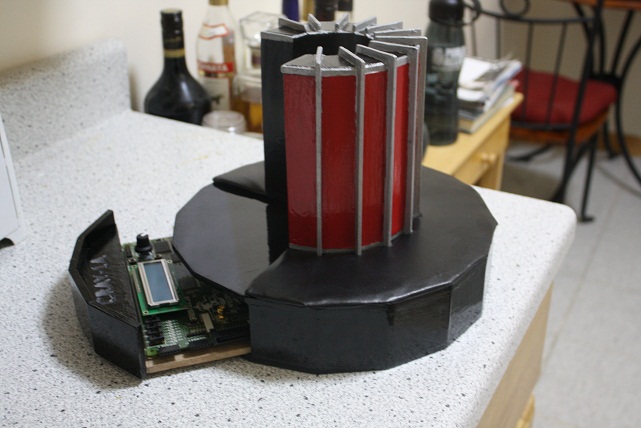
Recently a man by the name of Chris Fenton decided to make a 1/10th WORKING scale model of the Cray-1A. This is no small feat, there is not a lot of surviving documentation for the Cray, nor is there much of any software left (they were mostly retired from service by 1990).  Chris wished the Cray-1 to physically look like the Original (including the padded bench seat) as well as be binary code compatible.  His implementation runs at 33MHz on a Xilinx Spartan-3E 1600 CPLD.  Basically this is a dev board with a chip that has a complex array of programmable logic that you can program to do what you want.  In this case 1.6 million gates, about 1.2 Million of which are used in the design, significantly more the the original.

Cray-1A Model

The original Cray weighed in at 5.5 tons with the cooling system, and drew around 30kW of power. The 1/10th scale? will run on a few batteries.  Supercomputers are still an important part of computing, but as vector processing expands (what the Cray was orginally diesgned for)  such things as graphics cards can be used to perform much of the tasks of a supercomputer, and do so faster and cheaper.

Regardless, when people think of a Super Computer, they think of the Cray

September 13th, 2010 ~ by admin

The Increasing Threat of Fake IC’s

We have previously talked about the issue of fake IC’s.  The problem continues to get worse, and is making more and more press.  Almost 10,000 incidents of fake ICs were recorded by the commerce department in the US in 2008 (the most recent stats available). Each ‘incident’ is usually several thousand IC’s.  Over 2 million fake IC’s are seized per years, on average one shipment per hour of fake IC’s is caught and seized.  How many slip through is anyones guess, and likely much higher.

Some counterfeits are easy to spot

As infrastructure ages, and is kept in service well beyond its designed life, and well beyond the life of the IC’s that run it the issue of fakes gets more and more dangerous.  Normal manufacturers simply do not make these devices anymore, so brokers fill the gap. Many of which are less then reputable.

Two options exist to help alleviate this.  First there is a small few manufacturers who make new legacy components, based on the original masks of the original devices. Rochester Electronics (REI)  is perhaps the best known and largest, manufacturing over 20,000 part numbers to OEM spec. Innovasic also makes ASIC based OEM compatible devices.

The second is building a network of authorized distributors.  These are distributors that stock IC’s that are no longer made and are trustworthy.  The Authorized Directory is a site that allows searching of such distributors as well as news about the counterfeiting problem and what is being done about it.

As collectors counterfeit ICs are hard to deal with.  Museums don’t tend to purchase in quantities enough to warrant purchase from large distributors.  Collectors do however work together to help find counterfeit IC’s and determine easier ways to spot them.

More Info at Mercury News

Tags:

Posted in:
Museum News

September 10th, 2010 ~ by admin

$23,000 for a 1MHz Computer – Only if its an Apple 1

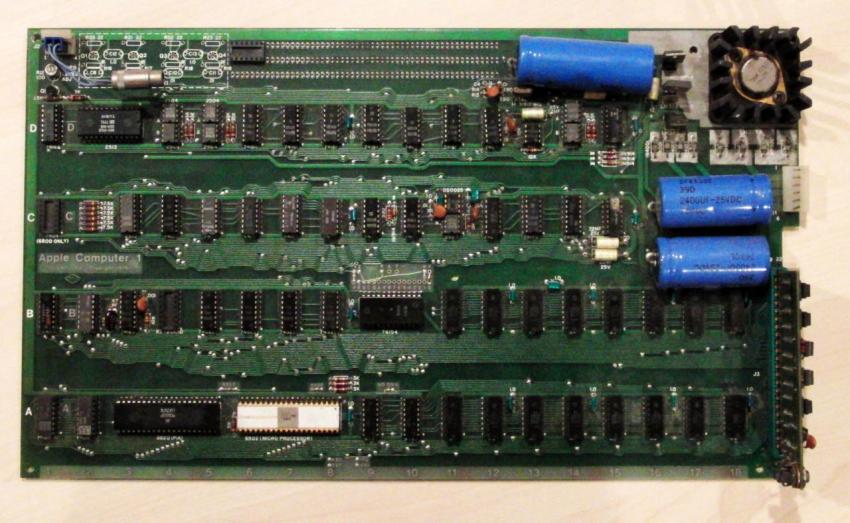
A nice Working Apple 1 computer with much documentation was just (minutes ago) sold on eBay for $22,766.66.  Early computers (and the chips that make them work) are greatly increasing in value.  Especially if it happens to have the famous Apple name and customizations done by Wozniak himself.

Apple 1 Motherboard

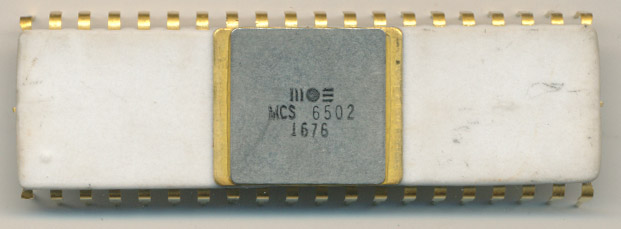
The CPU on this board is a MOS 6502 in a beautiful white ceramic package.  It moved 8 bits of data at 1MHz.

MOS MCS6502 1976

Many other computers from the 1970’s are now worth thousands of dollars as well, such as the IMSAI 8080 and the Kim 1

Tags:
,

Posted in:
Processor News

September 4th, 2010 ~ by admin

From Video Games to Deep Space – The RCA 1802 COSMAC

iFixit has been doing a series of ‘retro’ teardowns. Looking at various early video game consoles. SO far they have done the following:

All of these systems are pretty interesting designs, however we are going to take a peek at the RCA Studio II.  This was RCAs try at the video game console market that was emerging in the 1970s.  It sadly was outclassed soon after its introduction by the likes of the Atari 2600 and was discontinued after a mere 2 years.  At the heart of the Studio II was a CPU that RCA developed in 1976, a CPU that has outlived the Studio II, and many many other consoles, in fact the RCA COSMAC 1802 (the single chip implementation of the 2 chip 1801) is still made today by Intersil.

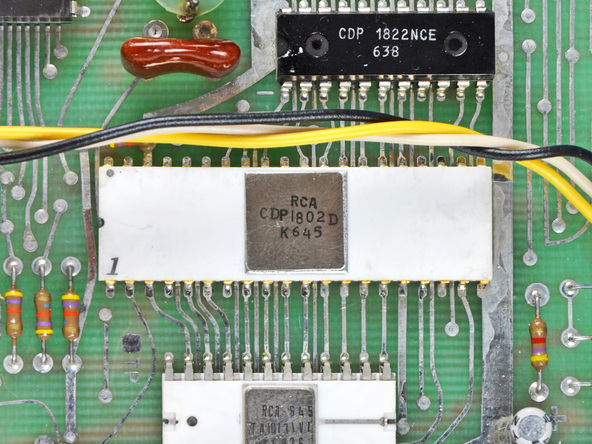
RCA Studio II 1802 Processor - 1976

The 1802 in the console iFixit used is a very uncommon white ceramic package, and is dated 7645, the 1802 was introduced in the first half of 1976 so this is a very early example.  The 1802 was one of the first static CMOS designs.  It didn’t have a minimum clock frequency so could be sped up/down according to the needs of the design (and power constraints). In the Studio II it ran at 1.7MHz. Other versions ran at 3.2MHz-6.4MHz.  One interesting note with the design of the COSMAC was that its frequency responded nearly linearly with supply voltage.  At the standard supply of 5V the frequency was 3.2MHz, However, double the supply voltage to 10V and the 1802 would be able to run at 6.4MHz (this only on certain specs of the chip obviously)

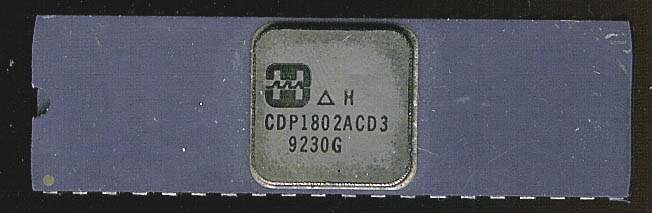
Harris CDP1802ACD3 -1992

Today the 1802, due to its flexible 16×16 register design, and well known reliability in harsh environments lives on in dozens of satellites circling the Earth.  It was also used as the main computer (6 1802s actually) in the Galileo deep space mission to Jupiter.  Many of the CPU’s designed in the 1970s (and often used in video games of the time) still are made (by Intersil now) and used today.   THe 1802, 6502, PIC16, and 2901 to name a few.  So next time you enjoy the weather report, or watch some satellite TV, its likely that a CPU designed over 35 years ago is being used to get that content to you.

Tags:
,

Posted in:
Just For Fun