Happy Thanksgiving
Happy Thankgiving to all our readers and supporters around the world. Eat lots of turkey, or whatever ya like.

We’ll likely have a few interesting processor news stories as well.


Total CPU's: 20,000+
Total Manufacturers: 150+
Total EPROM's: 2000+
Happy Thankgiving to all our readers and supporters around the world. Eat lots of turkey, or whatever ya like.
We’ll likely have a few interesting processor news stories as well.
In September a Apple 1 computer with a few accessories sold for $23,000. Christie’s has just auctioned off an early (first run) Apple 1, with invoice, shipping box, letter from ‘Steven Jobs’ and many accessories for a staggering $213,600. This would have been one of the original PCB’s, sold without components and later assembled by someone else. The main CPU is of course a 6502 but in this case a R6502P by Rockwell made in late 1981.
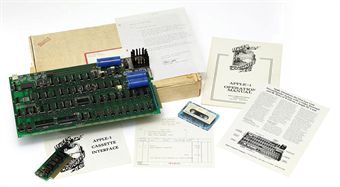
Complete Apple 1
What made this one so much more valuable? The documentation and original box. Whoever bought it should however replace the CPU with a white ceramic MOS 6502 to preserve the beauty of the original Apple 1.
Snap! Just 4 days after we posted about next generation Applications processors Qualcomm has announced the next version of the Snapdragon, the MSM8960. They are moving to a 28nm process (likely TSMC or Global Foundries) and of course dual cores. Qualcomm is also promising a 5x performance increase, which means they are likely reworking the Scorpion core and likely adding Out-of-Order Execution which offers a significant speed boost. Graphics speed will also be increased with an updated Adreno graphics core. The other important detail is that the MSM8960 supports all 3G and LTE modes, making it a single chip solution for pretty much the entire world market. It also, of course, integrates bluetooth, wifi, and GPS.
This should put Qualcomm in a very competitive position against the Tegra 2, OMAP4, and the new Samsung Orion.
All of this at a 75% reduction in power levels. Suddenly my HTC Incredible, isn’t.
AMD recently released the Bobcat line of APUs (Accelerated Processing Units). These are part of their new ‘Fusion’ line which integrates fairly simple, yet fast, CPU cores with Radeon graphics. Several sites have benchmarked the Bobcat against the Intel Atom and the results are rather amazing. Engadget has a list of benchmarks as well.
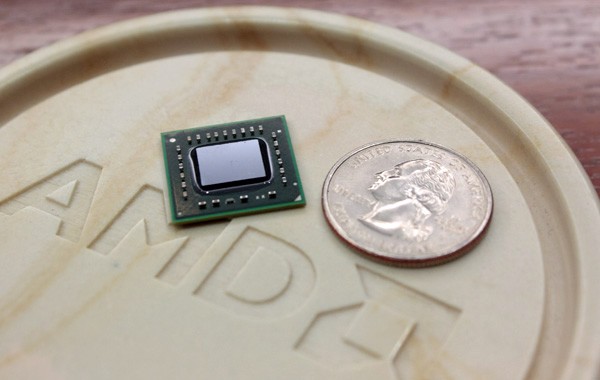
AMD Bobcat Fusion APU - Zacate
The dual core 1.6GHz E-350 dissipates a mere 18W, and containing a Radeon 6310 500MHz 80 core GPU. In various application tasks it handily beats the Intel Atom, and in video tests (gaming etc) its integrated Radeon GPU does remarkably well. Its good to remember that the E350 (and others in its family) are designed for netbooks, tablets, etc. Its good to see AMD taking a bite out of Intel’s Atom. Its this sort of competition that drives technological advances, and makes processors out of date fast enough for CPU collectors to pick them up.
 On November 20th, 1969 a small company was formed in Mountain View, CA called Scientific Micro Systems Inc (SMS). They would join the dozens of post-Fairchild semiconductor startups in Silicon Valley. Many of these we remember and know well, Intel, AMD, Zilog, MOS all are familiar and have designed processors that left a story, if not a legacy, in history. SMS has became a forgotten player in the roaring 70’s but they did introduce a few important things to the market. First 4096-bit bipolar Schottky ROM? SMS. First 256-bit bipolar Schottky RAM? Again SMS.
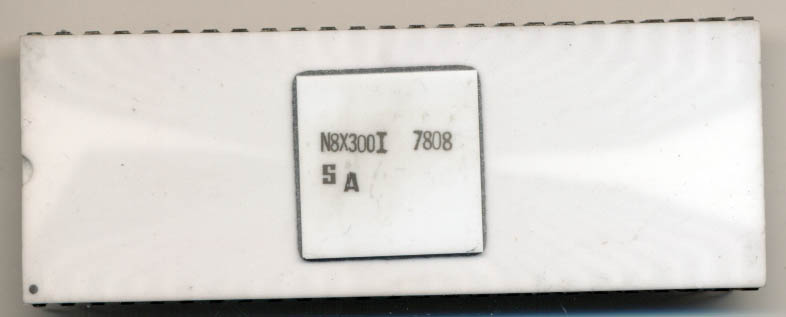
Signetics N8X300I – Early 1978
In January 1975 SMS announced prototypes of their own 8-bit microcontroller. The SMS300 was a non-traditional design. It focused on manipulation of signals. It had 16-bit instructions, but operated on data 8 bits at a time. It had very limited ways of accessing external memory (and no real way to access data memory). It was designed as perhaps the first DSP. It was fabricated in bipolar Schottky transistor technology. This allowed it to be incredibly fast (albeit very power hungry) for its time. Initial clock speeds were 6.66MHz and quickly ramped to 8MHz in 1976. The SMS300 was initially not available for sale as a single chip. It was sold as a single board computer called the SMS330 (as well as the SMS331 and SMS332) which contained everything needed to run the SMS300. This was packaged like a oversized 64pin DIP (similar to how some of the BASIC Stamp microntrollers are today). These systems started at $370 and topped out at $1460. In August of 1975 SMS ‘unbundled’ the SMS300 and began selling it (and its support chips) separately to those who wanted them.
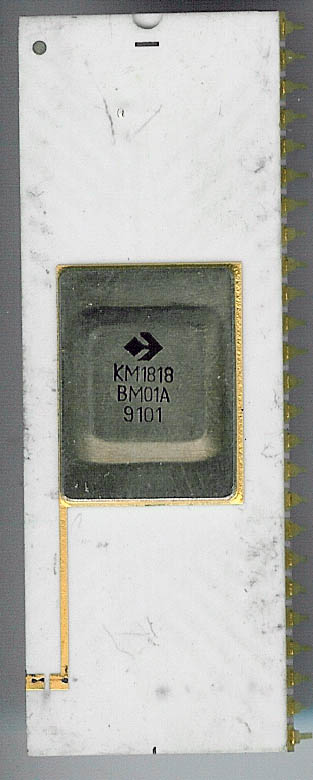
Soviet Electronika KM1818VM01A 8X300 Clone
SMS did not make the SMS300 themselves, they contracted another Silicon Valley company to fabricate them. Signetics, founded in 1961 by ex-Fairchild workers, was the first company founded to solely manufacture ICs rather then discrete transistors. In 1975 Signetics was purchased by Philips but continued to operate under the Signetics trademark until 1993. Signetics made all of the SMS300 devices for SMS, and in 1976 Signetics became a second-source, and could sell the SMS300 under the Signetics brand. By 1978 Signetics had purchased the rights to the SMS300 and renamed it the 8X300. 1977 or 1978 is generally when people think the 8X300 was develped. This is, unfortunately, due to forgotten history as by the time Signetcs bought the design, it had been on the market and in use for over 2 years. Signetics continued to make the 8X300 into the early 1990s where it found wide use in disk controllers, telecommunications and other DSP like environments. The N8X300 was also second sourced by AMD though I have yet to see one. The 8X300 was also *second sourced* by the Soviets in the 80’s and early 90’s by the Electronika state electronics company in what is now Voronezh, Russia. These of course were not licensed copies but they are however, still of interest.
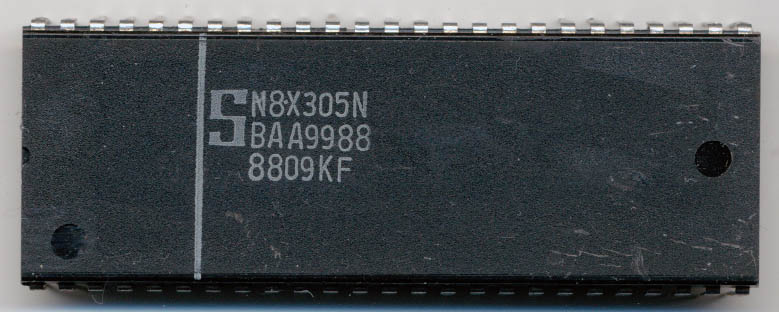
Signetics N8X305N Early 1988
In around 1982 Signetics released the N8X305, the successor to the 8X300. It was functionally compatible but increased the general purpose registers to 13 from 8 among some other instruction improvements that greatly improved upon the data handling deficiencies of the 8X300. Processor speed was also boosted to 10MHz. (200ns instruction time vs 250ns for the 8X300) The N8X305 also used the same pin-out as the 8X300 and the same 50pin DIP package (as well as adding a 68pin PLCC). AMD second-sourced the 305 as the AM29X305. The N8X305 continued to be made into the 1990s and saw use in many military applications as well. Because of this Signetics/Philips could not simply terminate production. They sold production rights to Lansdale Semiconductor Inc., who still offers the N8X305 to this day.
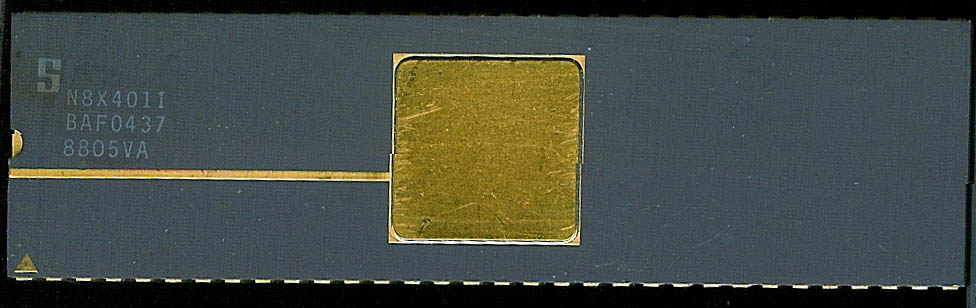
Signetics N8X401I – 1988
In 1986 Signetics again revised the design and released the N8X401. This processor now had a full 32 instruction (including a RETURN instruction allowing the use of subroutines) The N8X401 also added an 8-bit data bus making data handling somewhat simpler but also increasing the package size to a 64 pin DIP. Internal usable registers was increased to 16 and the instruction width was increased to 20-bits. Clock speed remained at 10MHz but it was now fabricated in ECL (Emitter Coupled Logic). This among other improvements, helped to result in a 35% speed boost over the N8X305.
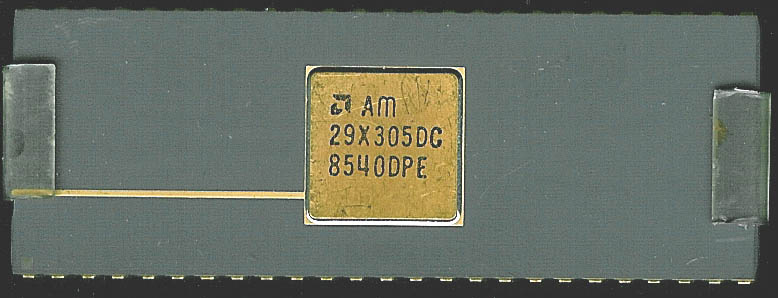
AMD AM29X305DC – N8X305 Second Source – 1985
The N8X401 was not a great success, primarily because of the competition at the time. By 1986 8-bits, even for a DSP, was rapidly becoming out of date, especially with such purpose built DSPs such as the Motorola DSP56000 and the industry standard setting TI TMS320 series.
Thus is the story of one of the most odd processors to come out of the chip boom of the 1970’s (EA 9002, MMI 6701, AMI S2000 et al). There are several other forgotten processors of that era which are also deserving of some remembrance. In time we’ll try to document their history here at the CPU Shack as well.
Current smartphones have an impressive amount of processing power, and its getting better yet. Samsung’s new Orion chip has now been spotted running in the wild. This is one of the first of the next generation of mobile Application Processors.
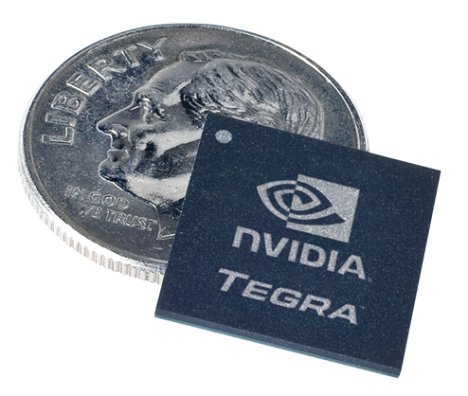
Nvidia Tegra
In 2008 a smart phone would have a ARM11 class processor running at around 500MHz. The original iPhone, and the iPhone 3G used one made by Samsung running at 412MHz. The first Android phone (the Google G1/HTC Dream) used a 528MHz Qualcomm MSM7201A ARM11 processor. The original Nvidia Tegra CPUs also fall into this class. We’ll consider this the first generation of the TRUE smart phones as before the iPhone, smart phones were of limited use, and rarely had things likely fully working internet browsing etc.
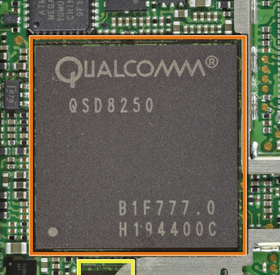
Qualcomm QSD8250 Snapdragon
The second generation of smart phones significantly increased in processing power. These are the phones that we use today. The majority of these run on some version of the ARM Cortex-A8 processor. These processors are single core 600MHz-1.3GHz devices. Perhaps the best known are the Apple A4 (Samsung Hummingbird), the Qualcomm Snapdragon (really a custom ARM core called the Scorpion similar to the Cortex-A8 crossed with a Cortex-A9), and the TI OMAP3 series. Second generation Application Processors also have brought some pretty powerful graphics to phones. These are integrated onto the same die as the Cortex-A8 and usually are PowerVR (Apple/Samsung and TI), Adreno (Qualcomm from ATI), or Mali (ARMs own GPU) based.
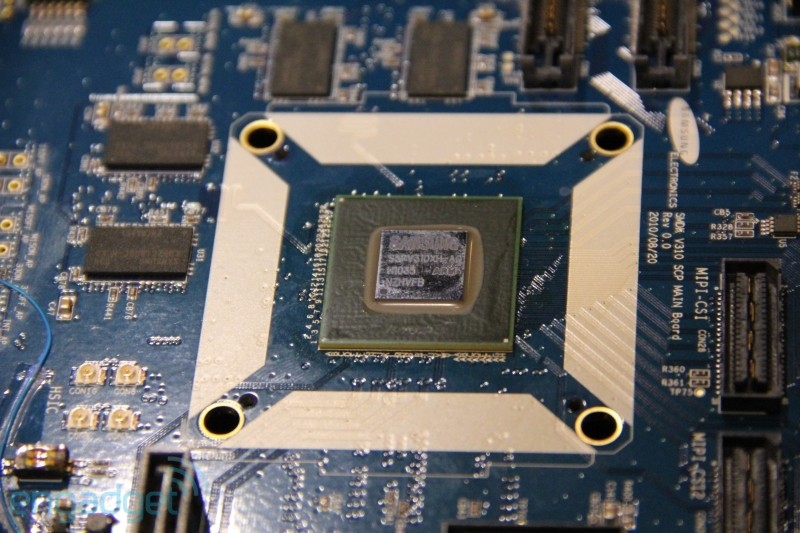
Samsung Orion ARM Cortex-A9 Dev Board
The smart phones of 2011 will begin using the third generation of Application Processors. These are defined by being based on the ARM Cortex-A9, a faster and more efficient ARM core, as well as typically being a dual core (or better) device. The TI OMAP4 series fits this description. Qualcomm will continue with the Snapdragon line, but bring it to a dual-core 1.5GHz chip. Apple is an unknown, but will likely up the speed of the A4, or add a core to it. Samsung;’s Orion is a dual-core 1GHz A9 with a quad core Mali GPU. It also packs 32KB of L1 cache per core and a full 1MB of L2 cache. Nvidia has the Tegra 250 already, which powers a handful of devices such as the Zune HD. These processors will handily run full 1080p video, as well as drive external displays. Your phone will soon be able to play movies on your TV.
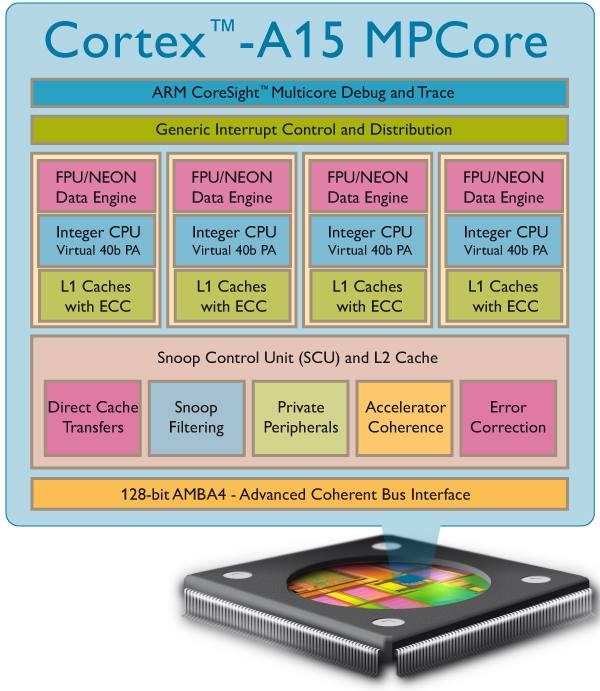
ARM Cortex-A15 Eagle
What will the future bring? ARM Cortex-A15, the Eagle, is a 2.5GHz quad core. Hopefully it can run without depleting our batteries in an hour.
Apple recently released the new (or rather updated) Macbook Air. 21 years ago they released their first laptop, the Mac Portable. It was not the success that Apple hoped, but the later PowerBook was. Mr. McCarron recently posted a pic of these side by side.
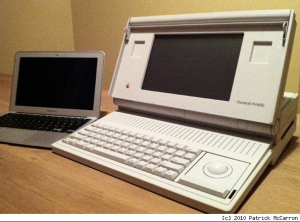
Mac Portable and Macbook Air
Needless to say in 21 years Apple was improved their laptops a fair amount. However there are some similarities. The Macintosh Portable shipped with no physical hard drive (a 20 or 40mb one was available as an option). It had 256k of onboard ROM (truly solid state storage). If you wanted more, you were stuck with floppies. Its RAM was handled by 1MB (expandable to 9MB) of SRAM, which was faster (then DRAM), and allowed an actual sleep mode. Technologizer did a tear down of one last year for its 20th anniversary which shows the guts rather well.
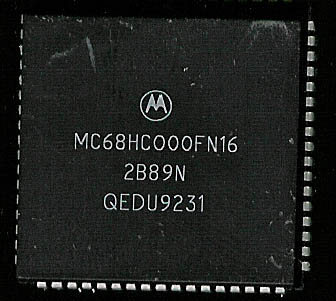
MC68HC000FN16
The CPU was a 16MHz CMOS version of the Motorola MC68000 (MC68HC000FN12F). The 12F is an ‘uprated’ 12MHz CPU that would run at 16MHz. Later Motorola released it as a standard part (the FN16 pictured here) The chipset was provide by VLSI who would go on to make the first ARM CPUs for the Newton line with Apple.
Just a few quick comparisons. The entire memory of the Mac Portable would fit in the L1/L2 cache of the CPU on a Macbook Air. The battery for the portable? 2.7lbs, heavier then the entire Air.
| Mac Portable | Macbook Air (2010) | |
| Processor | 68HC000 @16MHz | Core 2 Duo @ 1.6GHz |
| L1/L2 Cache | 0/0 | 128K/3MB |
| RAM | 1MB-9MB | 4GB |
| Storage | 256K (ROM) + Floppy | 128GB SSD |
| Screen | 10″ Monochrome | 11.6″ Color |
| Weight | 16lbs | 2.3lbs |
Uneasysilence has a great post of vintage tech ads from the 70’s and 80’s. Back when technology was rather nerdy, and well, so were the marketing departments it seems.
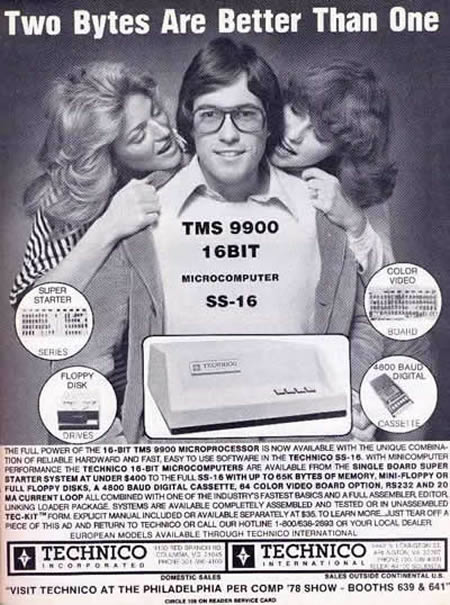
Texas Instruments TI 9900 Processor - 1978
Check them out, and if you know of more, let me know in the comments
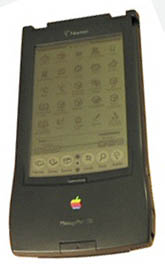
Apple Newton 120 - 1994
Cult of Mac recently interviewed John Sculley, the former CEO of Apple. The interview is long, and very interesting. Sculley presided over Apple during some rather rough times. Steve Jobs in fact still wont talk to Sculley. This is interesting, as it was Sculley, and the result of a failure that ended up saving Apple, or at least significantly helping them stay in business.
The Apple Newton is known as one of Apple’s biggest failures, however, it ultimately brought relief to the company. Apple began the Newton project back in 1987. In search of a processor that could handle the OS, and run on batteries Apple turned to ARM, then a small British company known as Acorn, whose main business was computers and processors for Acorn computers and BBC Micro computers.
Acorn did not have the resources to design the processor Apple needed, so Apple, along with an Italian company called Olivetti took a 47% stake in Acorn. This cash infusion allowed ARM to develop the processor for the first Newton. The first Newtons, or MessagePads, as the ones made by Apple were branded, were powered by a 20MHz ARM610 processor. It was made by VLSI (the first silicon partner for ARM) and called the VY86C610. They were introduced in 1993 and continued production (in various forms) until 1997. Sharp, Motorola and several other companies also made Newton OS devices, but they enjoyed even less success then Apple’s.
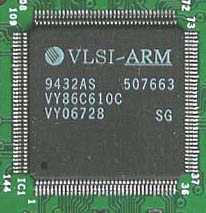
VLSI VY86C610C 20MHz ARM610
In 1997 Apple releases the eMate 300, a classroom targeted laptop system. It ran the slightly more advanced 25MHz VLSI VY86C710A ARM710A. The styling of the eMate seems to have carried over to the first iBooks with translucent, rounded cases.
The last of the line was the MessagePad 2000 and 2100, both of which were based on an ARM processor made by DEC and Intel called the StrongARM SA-110. It ran at 162MHz and was at its time one of the highest performing designs for mobile devices available. Intel later developed the XScale line of processors from it, which they then sold off to Marvell.
In 1998, among diminishing sales, Apple closed down the Newton division. Some of the original developers of the Newton OS went on to create a company called Pixo. ARM IPO’d that years as well as ARM Holdings. Apple sold their stake in ARM for $800 Million. This influx of cash came at a time when it was desperately needed by Apple, and gave them the time, and money they needed to ‘reset’ and return to profitability in a VERY strong way.
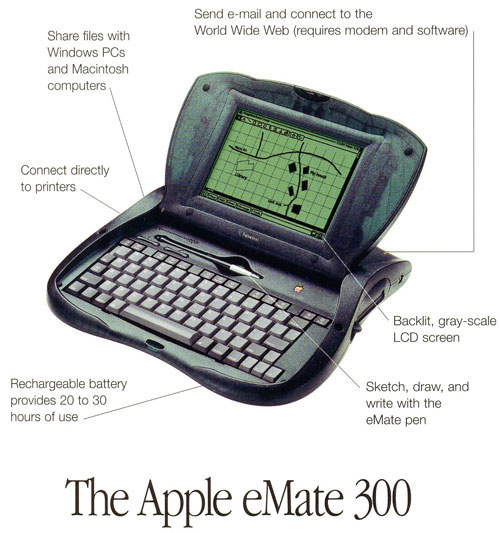
eMate 300 ARM710A - 25MHz
A mere 3 years later, in 2001, Apple ‘changed everything’ with the release of the iPod. The iPod ran on a dual core 90MHz ARM7TDMI processor made by PortalPlayer. It ran an OS designed by Pixo. Apple subsequently bought Pixo, and likely returned a few old Newton employees to their old desks in doing so. All further iPods, iPhones, and iPads, and now the iTV run on ARM processors. From the lowly 20MHz of the ARM 610 to the 1GHz+ of Apple own A4. The company that Apple helped get started, is now at the foundation of Apples core business.
And it was all because of a ‘failure,’ the Newton.
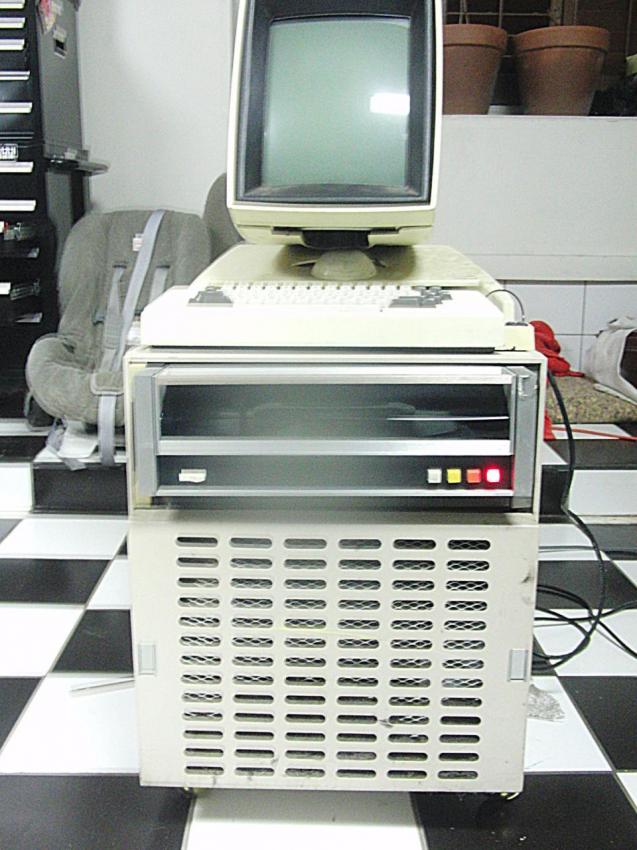
Xerox Alto-II XM
Just last month an Apple 1 computer sold on eBay for almost $23,000. Today, the father of the PC, and where Steve Jobs got many of his inspirations (as did Bill Gates and numerous other founders of the computer industry), sold on eBay for a bit over $30,000.
The Xerox Alto was really the first modern computer as we know it. It was developed at the PARC research center, and had Ethernet, a mouse, a GUI, and assorted other things we are rather use to now. The date? 1973. Xerox did not understand the significance of what they had. They made over 2000 Altos of various configurations, but never sold them, most were simply given away to friends, workers, and universities.
Though never sold, the Alto’s value in the 1970s was $32,000 or so, not a far cry (disregarding inflation) of what a non-working one just sold for on eBay
The Alto was powered by a custom16-bit bit-slice processor consisting of 4 TTL 74181 ALU’s one of the first uses of the 74181, which was itself the first single chip ALU.
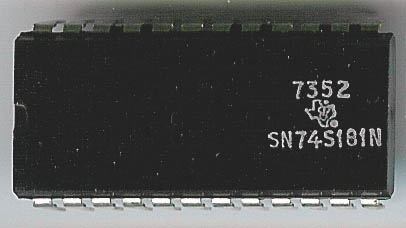
TI SN74S181N - Late 1973 - 90MHz
The 74181 consisted of around 75 gates, and could perform 16 arithmetic functions and 16 logic functions on a pair of 4-bit inputs. It was, for its time, very fast, much faster then most of the single chip processors of the time. A 74S181 like shown here, using Schottky technology, could operate at up to 90MHz or so. Obviously in a computer like the Alto actual clock speed would be reduced to match what the memory could do, which in the Alto, with its 128K of RAM, worked out to 5.8MHz.