April 7th, 2011 ~ by admin

The Commodore is back!

Commodore USA has started taking pre-orders of its newly revamped Commodore 64 Home Entertainment system.   Of course this version comes with Blu-Ray and a dual core Intel (gasp!) processor running a version of Ubuntu Linux, it will include a Commodore OS 1.0 emulator, which should run all your favorite C64 6502 based games.

Commodore USA C64 - 1.8 Dual core Atom - 2GB RAM

The Original C64 had 64k of RAM, the Intel Atom D525 has 112k of just L1 cache.  At least the die size is similar :).
Commodore USA is also making modern version of the VIC computers for your enjoyment, albeit in slightly modified cases.

Tags:
,

Posted in:
Just For Fun

April 1st, 2011 ~ by admin

Osborne Computer: The Rise and Fall

Technologizer has published a very interesting article on Osborne Computers, and its founder, Adam Osborne.  Osborne computers was started 30 years ago (April 3rd 1981).  They were the fastest growing, and fastest failing company in Silicon Valley, impressive even today. Adam Osborne was one of the most important people in Silicon Valley (along with Bill Gates and Steve Jobs).  His books in the 70’s are still invaluable resources for collectors, I have several editions of ‘An Introduction to Microcomputers’ which provide an invaluable reference to some of the chip designs of the 1970’s and early 1980’s.

The Osborne 1, the first wildly successful portable, was based on a Zilog Z80A processor and ran the then popular CP/M OS.  If it wasn’t for cash flow problems, Osborne computers may very well have still been making computers today.  It is also interesting that Mr. Osborne had a habit of picking designs that ended up to be not very successful (he chose the Zilog Z8000 and Intel 8089 I/O processor as ‘Chips of the Year’ in 1980)

Tags:
,

March 31st, 2011 ~ by admin

CPU of the Day: MMI 6701 Bit-Slice

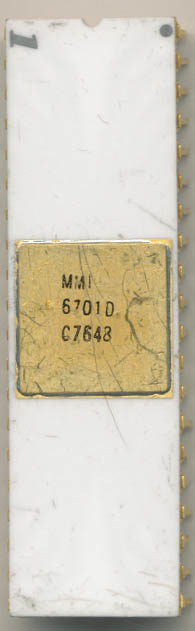
In 1974 Monolithic Memories Inc. (MMI) announced the 6701 bit slice device.  At its heart the 6701 is a 4-bit ALU much like the 74181 TTL IC.  The 6701 adds a register, and some other support circuitry on chip making it much more adaptable.  The 6701 has an approximate complexity of 1000 gates (meaning it would replace 1000 gates worth of TTL).  The 6701 was made on a bipolar process and ran at 5.2MHz.  Later versions would up this speed to around 11MHz.

6701D - 1976

The 6701 continues on until around 1980 by which time the AMD 2901 bit-slice processor had come to completely dominate the market.  The Soviets however cloned/modified the 6701 as the 1802VS1 through the 80’s and into the 1990’s.

Posted in:
CPU of the Day

March 17th, 2011 ~ by admin

Chips of the day: TI TMS320E The tale of the two dies

Its fairly common for a manufacturer to make several devices out of a single actual die.  Just disable part of the die, whether because its faulty, or not needed, or simply do not connect the pins to that feature.  Intel did this a lot with the Celeron, and PIII line, disable some L2 cache on a PIII and you get a Celeron.  Today it is done with multi-core processors.

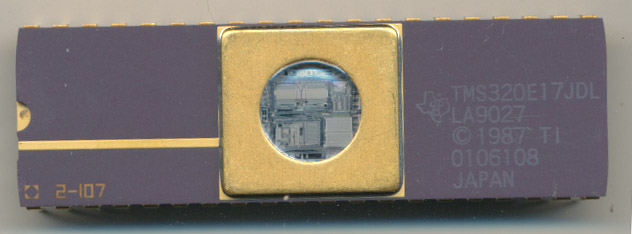
TI TMS320E17JDL

Using a common wafer for several products saves a large amount of money, no need for a second mask set, and testing systems.  Here we have a Texas Instruments TMS320E17JDL.  The TMS320 is the industry standard in DSPs (Digital Signal Processors). The E17  from 1990 runs at 20.5MHz has a 4K EPROM, 256 bytes of RAM, and a pair of serial ports.  You can see the large sections of the die devoted to the ROM, RAM, and MAC (Multiply and Accumulate).

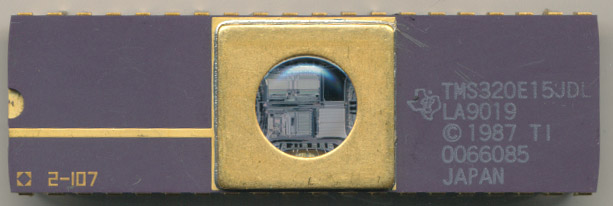
TI TMS320E15JDL

This is the TI TMS320E15JDL.  It is the same basic DSP core as the E17, it includes the same 4K EPROM, the same 256 bytes of RAM and the same MAC unit.  It has some I/O ports tasked with doing different things, but thats a relatively minor difference.  The big difference is the E15 lacks the 2 serial ports of the E17.  You can see on the die where that hardware does not exist, its a large black spot, void of any circuitry.  A very interesting and unusual occurrence.

TI either used a completely different mask for the E15, or they simply chose to not expose that small part of the mask.

Tags:
,

Posted in:
CPU of the Day

March 12th, 2011 ~ by admin

Apple A5 Updated Info

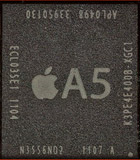
Now the UBM Techinsights and iFixIt have completed their teardowns of the iPad 2, and benchmarks have been run we now know that the A5 is in fact a dual core, made by Samsung, and clocked at around 900MHz.  It also includes the PowerVR 543 dual core GPU as we suspected in our previous post.

Apple A5 Processor

Also we now have an actual image of the chip, rather then the photoshopped one Apple used in their presentation.

Tags:
,

Posted in:
Processor News

March 6th, 2011 ~ by admin

CPU of the Day: NS87P50R-6: Piggyback CPUs

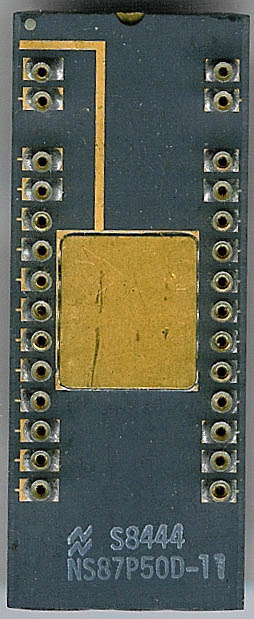
National Semiconductor NS87P50D-11

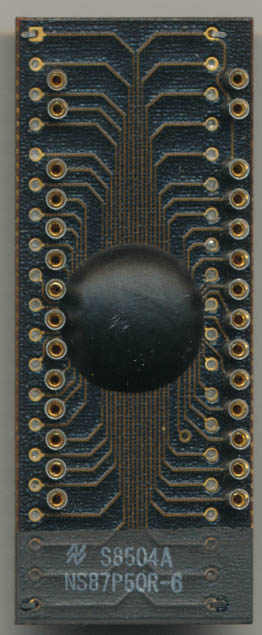
National Semiconductor NS87P50R-6

In the 1980’s most high-volume microcontrollers were OTP (one-time-programmable) or were factory programmed (Mask ROM).  This made developing code for them a bit tricky.  Some companies made lower volume version with an onboard EPROM, such as the Intel 8751.  Other designs this was not practical so another solution had to be found.

The most common solution became the ‘piggyback’ package.  The CPU would reside on a ceramic (pictured on the left) or organic (on the right) package that had a socket on top of it for an EPROM.  This provided an easy way to develop code for the processor, and EPROMs could be stopped out and erased at will.  Obviously these ‘piggyback’ parts were not intended for production use, their cost would be much to high for that.  They were made in relatively small quantities solely for engineering and prototype work.

This National Semiconductor NS87P50R-6 is a 6MHz MCU.  It includes a 24-pin socket on top that supports up to a 32k EPROM (2758, 2716 or 2732).  The other group of 4 pins on top are yet another feature.  It would be cost prohibitive to make a separate development device for each member of the MCU family so the 87P50 can be told to emulate several.  It can emulate a 8048, 8049, or if all jumpers are removed, the 8050. (The only difference in these is the RAM size, 64bytes, 128bytes, or 256bytes for the 8050).  The NS87P50R-6 is in an organic package, the die is actually placed directly on a circuit board, and covered in a black epoxy.  This is rather less expensive then the NS87P50D-11 ceramic and gold version, though is not as tolerant to heat.

If you have ever taken apart a cheap consumer electronic device, you will likely find a black ‘blob’ on the circuit board.  Thats a die, and usually the microcontroller of that device.  ID’ing it is next to impossible without acid and a microscope however.

National Semiconductor was not the only company to use this type of design.  Zilog and Synertek used it for the Z8 series, Hitachi for the HD6301, Mostek for the 3870 and most all other companies that made a MCU int he 1980’s.

Tags:
,

Posted in:
CPU of the Day

March 5th, 2011 ~ by admin

The Windows Upgrade Path: Windows 1 to Windows 7

Andrew Tait decided to see if an install of Microsoft’s original Windows, could be upgraded through each version to end up at the current version.  Its amazing that yes it worked, and that Windows 3 programs continued to work in Windows 7.

Perhaps even more remarkable, is that Windows 1 was deigned to run on an 8086 processor, clocked at 4.77MHz with 256k of RAM. Using VM Ware it can still be run on modern hardware.

A parting thought…The entire Windows 1 OS will fit in the L2 cache of any modern processor.

Posted in:
Just For Fun

March 2nd, 2011 ~ by admin

The iPad 2: Apple joins the Dual-core crowd.

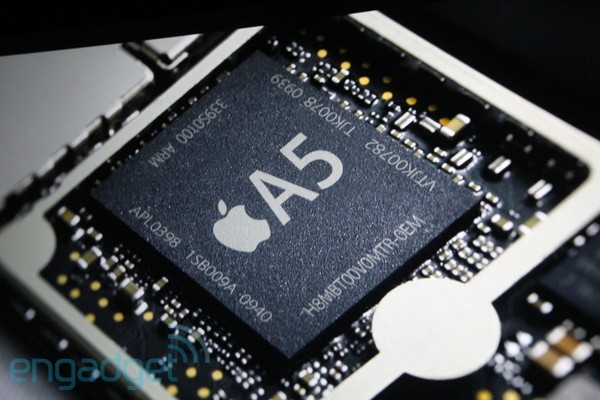
Apple A5 - Actually a Photoshop'd A4

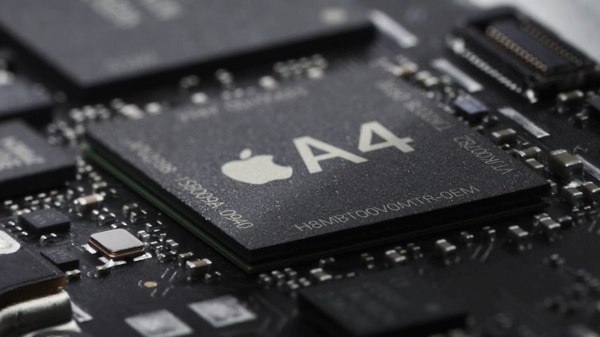
Today Apple announced the iPad 2, which unless you are living in a cave, you likely have heard about more then you wish already.  The iPad 2 debuts the next evolution in Apples own ARM processor.  The A4 (which was a single core 1GHz class ARM Cortex-A8 made by Samsung) is out, and a dual core replacement is in.  Details are thin until a proper tear down is done, but it is most likely a 1GHz dual core ARM Cortex-A9 with a dual core PowerVR 543 replacing the single core PowerVR 535.  It is most likely fab’d again by Samsung.  Apple’s press shot during their presentation is NOT an A5, the PR folks at Apple simply Photoshopped the original press shot of the A4 from last year. Note the date codes on the chip are 0939 and 0940 (sine their is 2 dies in it), which is late 2009.

Apple also made the somewhat deceptive remark that the iPad 2 is the first dual core tablet to ship ‘in volume.’  HP’s Touchpad runs a dual core Snapdragon and is shipping ‘soon.’  LG is shipping their tablet this month with a very capable Tegra 2, and Samsung will follow with the Galaxy Tab 10.1, also Tegra 2 powered.  RIM’s Playbook which is in beta, used a TI OMAP 4430 dual core Cortex-A9.  This puts Apple right in the mix of the dual core frenzy that will playout this year.

Apple A4 Press shot, notice the identical markings to the A5

We’ll update the photo as soon as someone (likely the folks at iFixIt) get and tear one down.

Tags:
, ,

Posted in:
Processor News

February 20th, 2011 ~ by admin

Russian Computers on the Buran Shuttle

In the 1970’s and the 1980’s the Soviets developed and successfully flew their own version of the Space Shuttle.  It was called the Buran.  In many ways it was an enhancements of the US Space Shuttle, based on what the Soviets saw as deficiencies in the US design.  One of the biggest differences was the piloting.  The US STS (Shuttle Transport System) was designed to be a crewed vehicle.  The computers assisted the pilot/co-pilot in launch, orbit, and recovery.  Many of the functions on the STS can be handled by the computers (the Flight Computers were based on the IBM System/4 Pi) but the pilot was needed to handle the rest.  The Soviets, on the other hand, designed the Buran to be able to launch, orbit, and land fully automatically.  This meant the computers has to be very robust, and the programming even more so.  The computers had to respond quickly to chaning inputs, and be able to handle failures gracefully.  While each mission would have a set profile, unknown conditions would cause deviations that the computers must detect, analyse, and properly handle.  Preferably without wrecking the multi-billion ruble space craft.

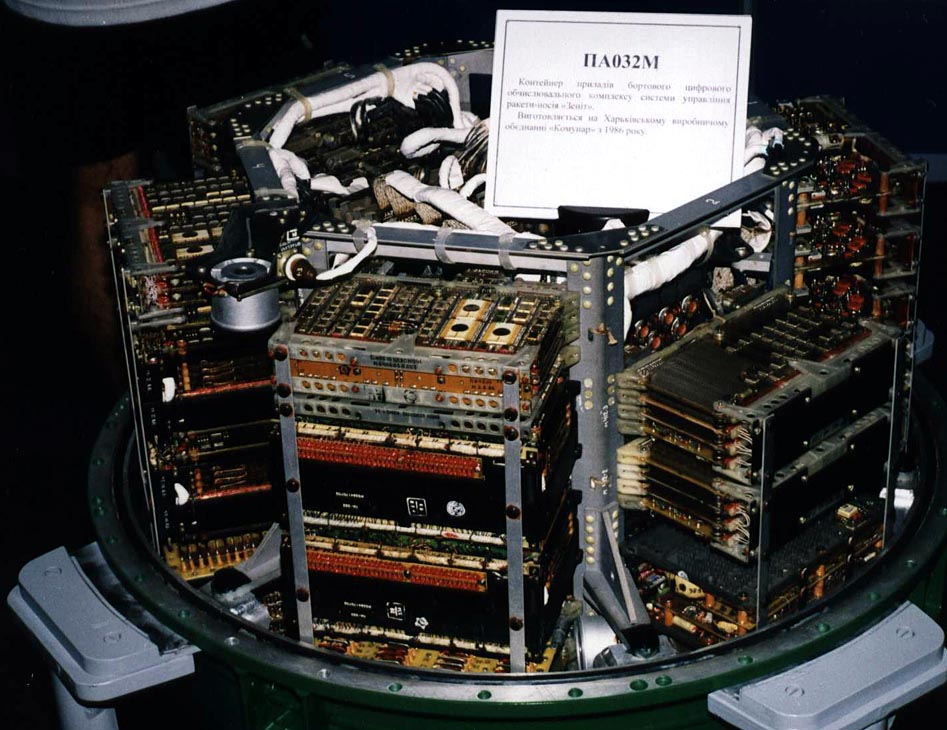
Buran Computer

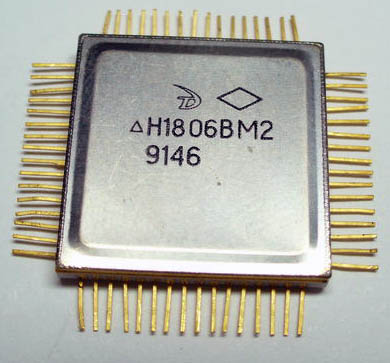
The main computer of the Buran is actually 4 independent systems that receive the same inputs.  The clock in generated externally (with 4 backups) so that each computer is in perfect time (the STS uses software to ensure the computers are in time, rather then hardware).  Redundancy is achieved by the voting system. Each computers outputs are compared, if one computers output is different, it is automatically shut down, leaving the 3 remaining computers.  These computers are powered by a clone of the DEC PDP-11.  The Soviet’s ‘acquired’ a few PDP/11 systems and then copied and cloned them into many different systems.  The most common is the 1801 a 5MHz NMOS PDP-11 type device.  The Buran used the 1806, which is the CMOS version.   Here is a general overview of the flight computer.

Angstrem CMOS N1806VM2 - MicroVAX

In addition to the 1806 there were many sub-systems with their own processors.  Details on these are a bit thin, however looking at other Soviet space computer designs it is very likely that many of these used the 134IP3 series of ALUs (a clone of the 54L181 TTL 4-bit ALU).  This chip is also used in the Argon-16 and Argon 16A computers of the Soyuz and Progress spacecraft that are still in use today.  Bit-slice devices were used extensively for many Soviet designs as it gave them a great ability to design custom processors to meet the applications needs.  The Argon-17, which was used for anti-ballistic missile work, was based on the 583 series, an 8-bi slice processor.  The C100 and C101 computers (used as weapons computers on the MiG-29) also use a BSP design.

Posted in:
Research

February 17th, 2011 ~ by admin

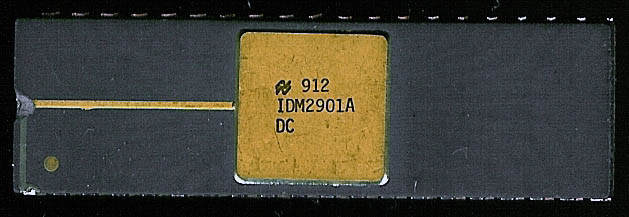
The AMD 2901 Bit Slicer and Second Sourcing

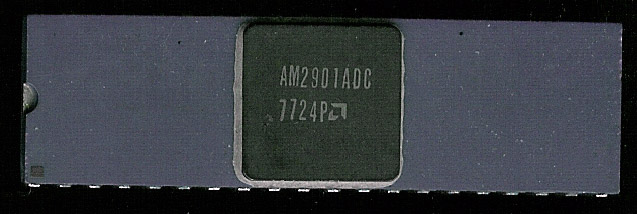
AMD AM2901ADC – 1977

In August 1975 AMD introduced the ‘100 ns Bipolar microprocessor.’ This was a bit-slice device. Essentially a 4-bit ALU (like a 74181) with functionality (scratch pad memory and accumulator register) to make it work as a processor that could be scaled to any bit width (using the 2909 sequencer and 2910 controller).  Being made in bipolar allowed for the high speed (10MHz at the time was pretty quick).  The introduction of the 2901 also marked the beginning of the end to the competition int he bit-slice arena.  A combination of marketing, second-sourcing, and a good product allowed AMD to completely dominate the bit-slice market.  Even today most bit-slice designs are based on the 2901 from 35 years ago.

At the time there were several other bit-slice processors on the market.  Intel had the 3002 (a 2-bit design), National’s IMP-8 and IMP-16, and the original TTL 74181 were all bit-slice devices.  MMI (which AMD bought in the 1980’s) had introduced the 6701 4bit slice in 1974, a full year before AMD’s 2901.  TI had the SBP0400A and Motorola the MC10800 (in ECL – 1976). So why with all this competition did AMD come to dominate?
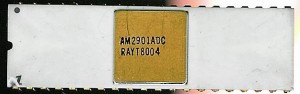
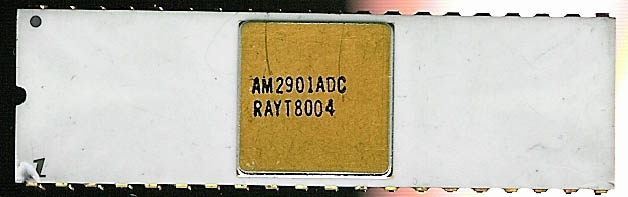
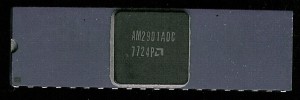
Raytheon AM2901ADC – 1980

Second Sourcing

Second sourcing is the licensing of a design to other companies for them to manufacture, market and sell it.  Sometimes its simply a license to manufacture, sometimes it comes with technical assistance, or even complete mask sets to make the device.  There are three main reasons this is done (or was done back in the day)
 

Guaranteed Availability.

In the 1970’s making IC’s was a relatively new process, one with many bugs, and often reliability issues.  Having a second source was a must to get a big design win. A system design would not want to design a system around a chip that may end up not being available, or not be available in the quantities needed.  Having a second source to get the IC from alleviated this problem.  It gave system designers a stable supply, regardless if the primary source could not keep up, or had a problem.
 

Distribution

Second-sourcing helped solve distribution problems as well.  A company may have an excellent design, but no way to sell it.  Often this was a geography problem.  American companies did not initially have a large presence, or distributors set up, in Europe or Japan.  An American company would often second-source a design to a European company (such as Siemens or Thomson) solely to get their design distributed in that area.
 

Marketing

One of the keys to a processors success is design wins.  It can be the best processor on the market,. but if no one uses it, it will fail.  Having additional companies make, and market the processor vastly increased its exposure.  Second-source companies would also typically make development systems, and other support tools, as well as vast documentation for the processor.  This helped ensure that engineers knew about the processor, how to use it, and whee to get it, ensuring its winning of more sockets.
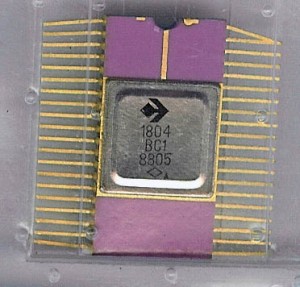
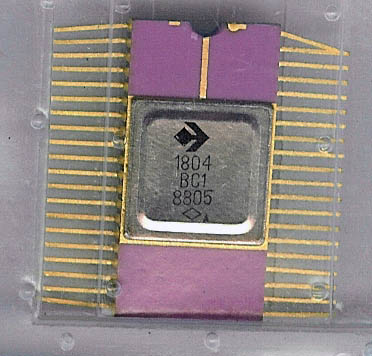
Soviet Electronika 1804VS1 – 2901 Clone – 1988

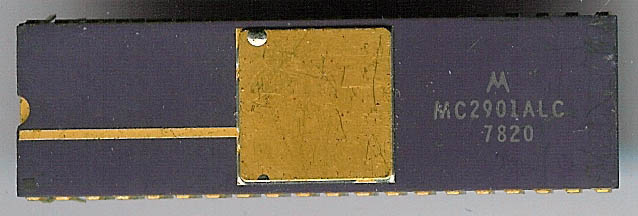
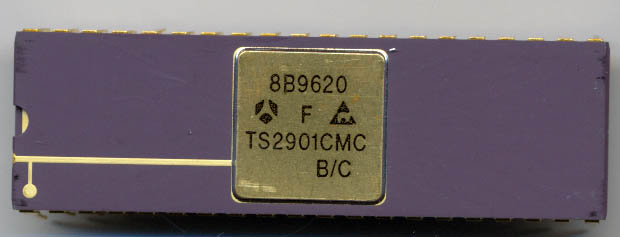
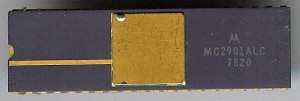
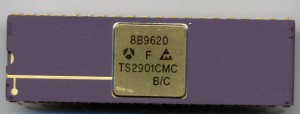
AMD clearly understood the importance of second-sourcing.  In November 1975, just months after the 2901 was released, they designed an agreement with Motorola to make the 2901.  In December, they signed up Raytheon, and in March of 1976 AMD signed an agreement with the SESCOSEM division of Thomson-CSF, to make and distribute the 2901 in markets outside the US and Japan. In June 1976 AMD amended their agreement with Motorola to include more technical assistance, ensuring Motorola could get the 2901 to market. In September 1976 MMI canceled the 6701, as they were unable to compete.  MMI had no second-sources for the 6701 which likely led to its failure.

As the years went by, AMD added more second-sources, and dropped a few. Eventually coming to completely dominate the bit-slice market.  The Soviets began to copy the 2901 around 1985 (not particularly legally but they did what they had to) and continued to do so until well into the 90’s.

Year Second Sources
1975 Motorola
1976 Motorola, Raytheon, Thomson
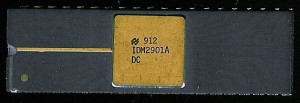
1977 Motorola, Raytheon, Thomson, National
1978 Motorola, Raytheon, National, Fairchild, NEC, Signetics, Thomson
1980 Motorola, Raytheon, National, Fairchild, NEC, OKI (MSM8821?), Thomson
1982 Motorola (2903), National, Fairchild, NEC, Thomson
1985 National, Thomson, Cypress, USSR
1990 Cypress, IDT, Thomson, National, USSR
1995 Cyrpress, IDT, WSI, Thomson, Russia

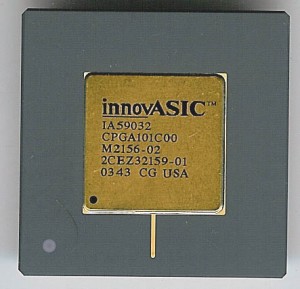
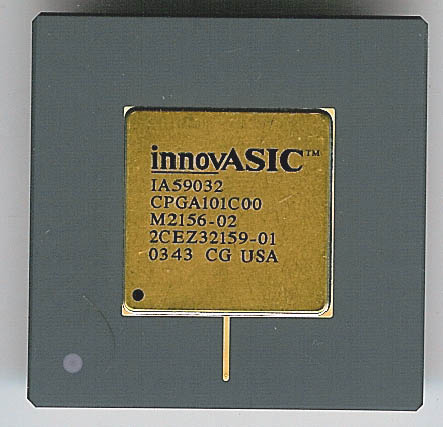
Innovasic IA59032 – 8 x 2901 – 2003

AMD also made the AM29C101 which was 4 2901s in a single chip, producing a 16bit processor.  Cypress manufactured a copy of the 29C101 called the CY7C9101

Several other companies also designed multiple 2901s into a single chip. WSI (and later InnovASIC) designed the 59032, which has the equivalent of 8 2901s to form a 32 bit slice and the 59016 which was  16bit slice (4x 2901).  IDT designed the 49C402 which was also a 16 bit slicer.  Today the 2901 is still in wide use, and while not generally used for new designs, it still powers a vast amount of electronic equipment that still is in use.  InnovASIC still manufactures the 2901 (in 59032 form) to this day.

Posted in:
Research