March 31st, 2010 ~ by admin
I’ve posted a fair amount about ARM processors, as today, they are in about everything. That was not always the case. ARM began with a small British company called Acorn Computers, who made various computers such as the BBC Micro (6502 based). They began developing a RISC processor in 1983 with their silicon partner VLSI. We recently received a few early versions of the ARM so here they are, with a brief history.
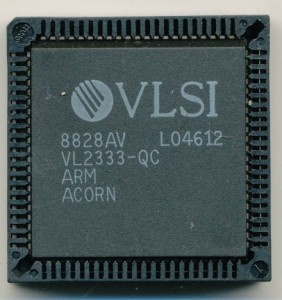
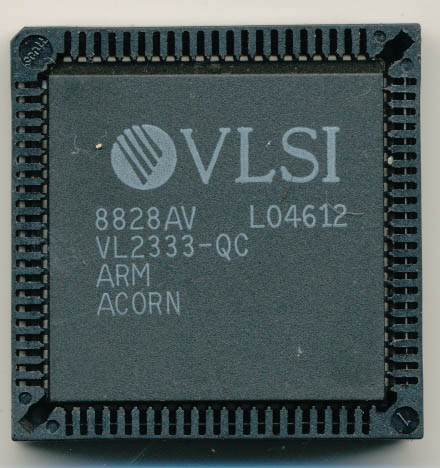
VLSI VL2333-QC 8MHz ARM1 CPU circa 1988
By 1985 they had the first working silicon of the ARM1 processor, a full 32bit design. It had around 25,000 transistors (compared with the earlier Motorola 68000 which had 70,000) so was relatively cheaper.
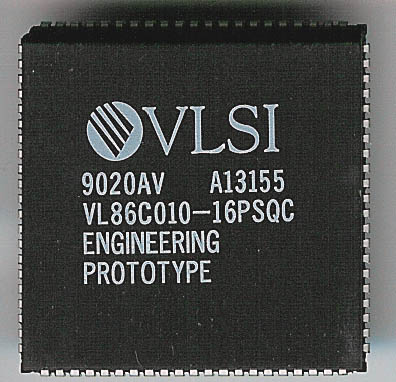
VLSI VL86C010-16PSQC 16MHz ARM2 CPU circa 1990 - Prototype
The next year the released the ARM2 processor, which added a hardware multiply instruction and ran at 8MHz. It had around 30,000 transistors.
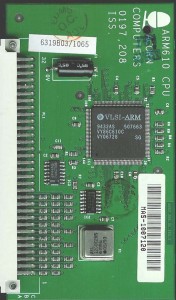
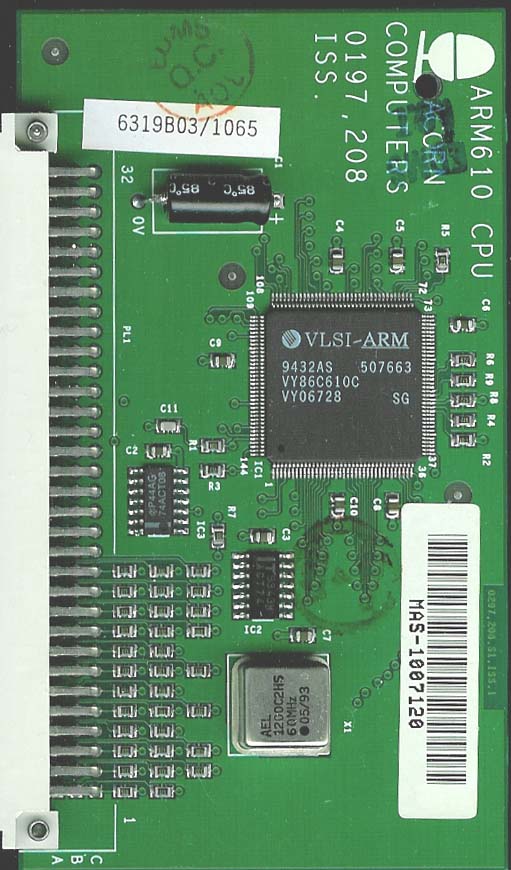
VLSI VY86C610C 30MHz ARM610 CPU circa 1994
In 1994 the ARM6 was released with higher clocks (up to 60MHz) and more features. The rest as we say is history, with many many varieties of cores available, at speeds over 1GHz, but STILL very small footprints. The ARM cores are licenses to hundreds of companies worldwide, and used in millions of devices, and it all began almost 30 years ago.
April 26th, 2009 ~ by admin
Often times its easier, and cheaper to break a big job down into smaller more manageable chunks. The same goes for processing, and back in the 70’s and 80’s was fairly common. ‘Wider’ processors were available, but were expensive and often not very flexible. Bit slice processors were invented to fix this. a BSP is essentially an ALU (Arithmetic Logic Unit) that was 2 or 4 bits wide. They could be put in parallel though to make processors of any width you needed. intructions and control would then be fed to them by a control/sequencer chip. Perhaps the most famous was the AMD 2901, a 4 bit slice device which is still in production today by companies like Innovasic.
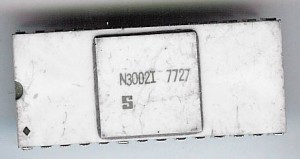
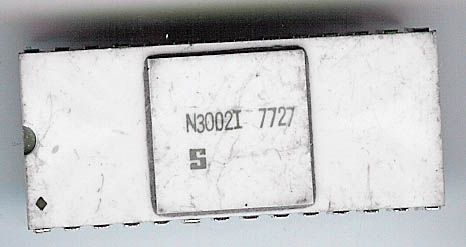
Signetics 3002 BSP
Intel also made a BSP, called the 3002. It was 2-bit slice processor and was second sourced by Signetics, as well as Intersil. Released in September of 1974, it was clocked at 6MHz, very fast for the time, and another reason BSP’s were so popular. Above is a Signetics made 3002 in an all white ceramic package. Fairly unusual in that the lid is also white.
April 10th, 2009 ~ by admin
A computer or device used in ones home has a pretty easy life. The temperature ranges are fairly conservative, and there isn’t constant vibrations. In addition, sitting in your home, you are not being bombarded with radiation (thankfully). However some computers are designed to be used in places where they are under such stresses. For example, in space based systems such as satellites.
Special CPU’s are made and tested for these applications, they have to be able to be exposed to radiation with having ‘soft errors’ and they have to work in extreme temperature ranges. -55C-125C is the standard military temperature range for such processors.
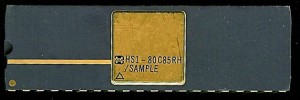
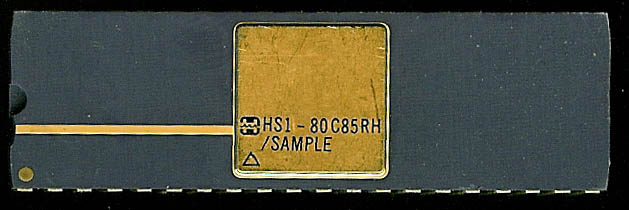
Harris HS1-80C85RH/SAMPLE
Here is a 8085 processor made by Harris Semiconductor (now Intersil). It is a sample of a device that would be used in such environments. A fully qualified chip would cost many thousands of dollars typically. This is because all of the time consuming tests that have to be done (including many devices that must be destroyed in testing).
April 4th, 2009 ~ by admin
SiCortex is a supercomputer company, or as they are called today ‘High Performance Computers’ (HPCs). HPCs have traditionally taken vast amounts of room, and vast amounts of power. SiCortex has changed that. Their fastest offers 5,832 1.4GFlops 64-bit processors, each dissipating just 900 milliwatts of power. All interprocessor communications logic plus two DDR-2 memory controllers and PCI Express I/O logic are on the same node chip with the multiple processor cores. Complete with its 8 Terabytes of system memory, the SC5832 fits in a single cabinet and only requires around 20 kilowatts of wall power.
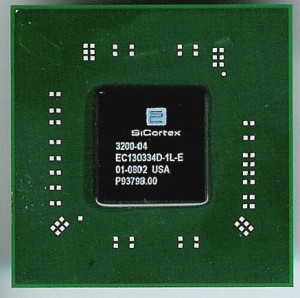
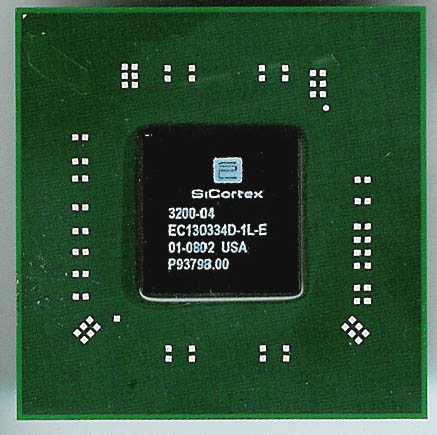
SiCortex Node chip
These nodes, shown above, each contain 6 MIPS64 cores running at 700MHz, a pair of DDR2 memory controllers, gigabit ethernet, an 8xPCI Express controller, and 256k of L2 Cache, quite impressive.
Much thanks to SiCortex for donating this node chip to the museum.
March 28th, 2009 ~ by admin
Microchip has now shipped almost 7 billion of the legendary PIC processor line. Still being made, and improved today, the PIC has been around for a very very long time. General Instruments created the PIC16 in 1975 to make up for the bad I/O of their CP1600 line. Later GI spun this off into Arizona Microchip Technologies in the late 1980’s and what is known today as simple Microchip.
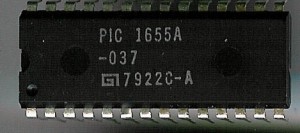
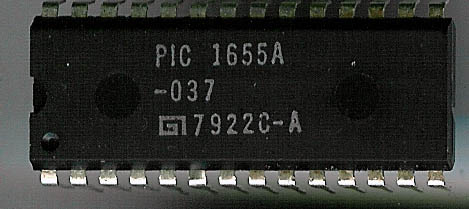
GI PIC1655A
Here is an original PIC1655A made in 1979.
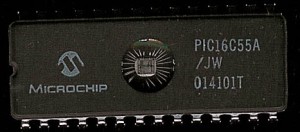
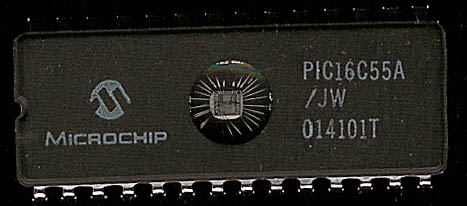
Microchip PIC16C55A
And here is the same part (albeit now in CMOS) made in late 2001. Old designs such as the PIC, and the MCS-51 remain immensly popular, they are inexpensive, and have over 30 years of code base to work with.
March 27th, 2009 ~ by admin
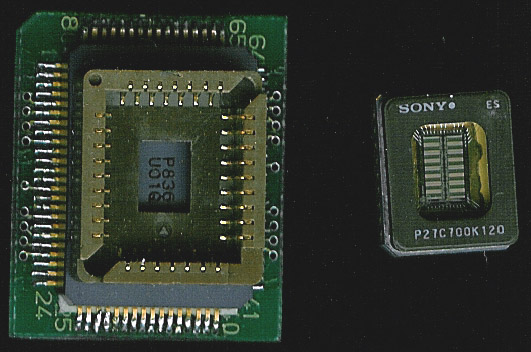
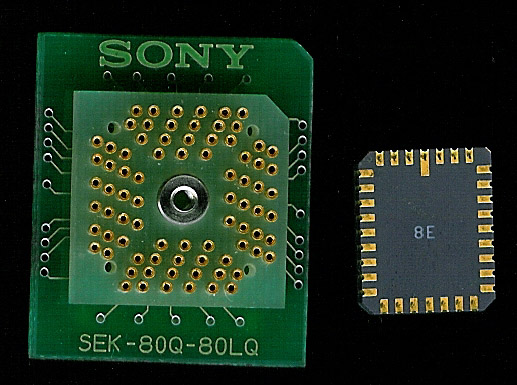
I recently was surfing eBay and found some Sony microcontrollers, while looking over the datasheet, I noticed the package looked very familiar, a stacked MCU, over a LCC EPROM. I have a similar device in the museum.
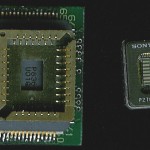
Sony CXP83601
I had not been able to previously identify it as all it said was P836U01, once I added the ‘CX’ in front, it all made sense, and I found its datasheet (albeit in Japanese) its a 10MHz 8bit SPC700 MCU w/ LCD controls and the EPROM is a highspeed 27512 type device (CXP27C7001)
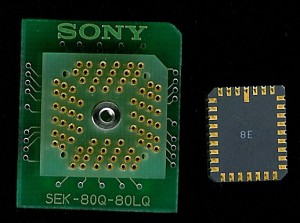
Sony CXP83601
March 12th, 2009 ~ by admin
ARM is solely an intellectual Property company. They design, and then license production of their ARM cores to other companies. However when they create a new core, they DO have it produced, in silicon for testing, and for use in toolchain makers to develop compilers etc for.
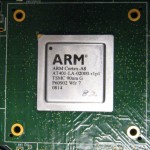
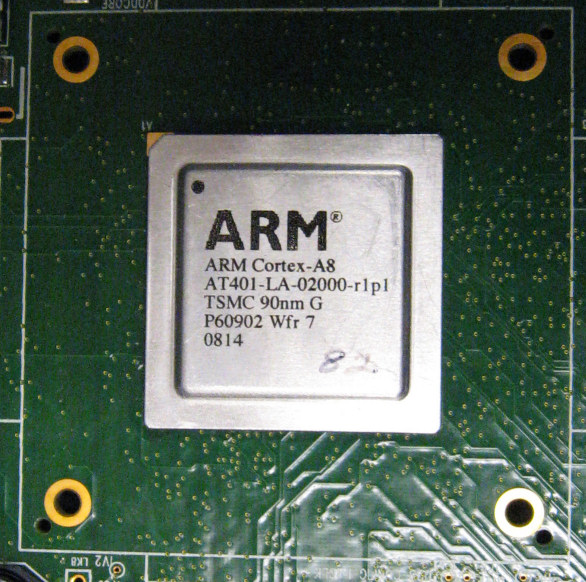
ARM Cortex-A8
Here are 2 such devices, one the ARM Cortex-A8, which in its fastest version (1100MHz+) can handily beat an Intel Atom in netbooks. The Cortex-A8 is used in the just release Palm Pre.
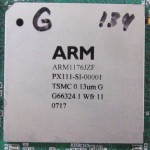
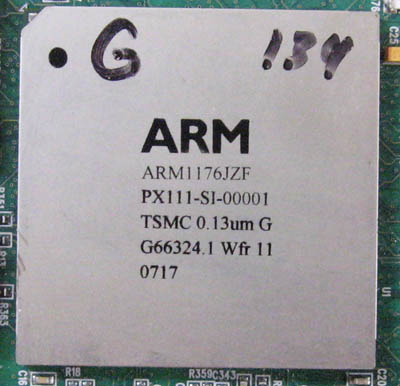
ARM1176
The ARM1176JZF is used in such devices as the iPhone. Both of these were fabbed by TSMC.
Thanks to Mr. Boys of ARM for the photos.
March 2nd, 2009 ~ by admin
Recently we have talked a lot about two important CPU architectures, the XAP, and the ARM. ARM recently announced the Cortex-M0 which is implemented in 12,000 gates. Today we received some samples from Ember, makers of very efficient ZigBee wireless chips. Their two main ZigBee solutions are the EM250 SoC, and the EM260 co-processor. As the heart of each of these designs is a XAP2b processor core. a 16 bit RISC design running at 12MHz and implemented in 12,000 gates.
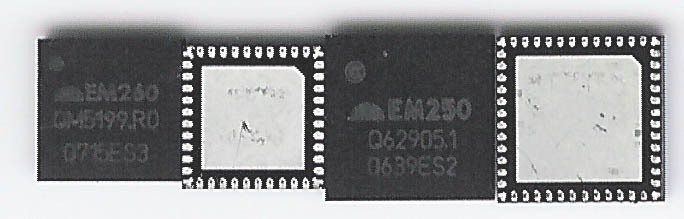
Ember EM250 & EM260 XAP cored ZigBee SoC's
The EM250’s chip area of a mere 7mm square, but pack an enormous punch, integrating a complete ZigBee wireless radio, 128Kb of flash, and 5Kb of RAM.
February 14th, 2009 ~ by admin
National Semiconductors COP8 family of microcontrollers has been around for many years now, and with over a billion shipped, in thousands of configurations, will be around for quite some time.
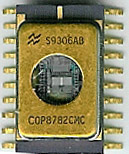
COP8782CMC
This is a rather unusual COP8 used for development purposes. This is the first SOIC I have seen in ceramic, let alone with the UV Window.
February 8th, 2009 ~ by admin
Last week we talked about Software Configurable Processors, and how they bridge the gap between general purpose CPU’s and FPGA’s. Yesterday a pair of them came in the mail.

Stretch S6000 & S6106
The S6100 is Stretch’s flagship product at this point (4 data ports full AIM interface and PCIe running at 345MHz). The S6106 is the low power device (2 data ports no AIM and no PCIe, clocked at 167MHz). This particular S6106 is an Engineering Sample. They are both based on the Xtensa VLIW core. (pic after the break)
Read More »