Warning: is_readable() [function.is-readable]: open_basedir restriction in effect. File(D:\Plesk\VHOSTS\cpushack.com\httpdocs/wp-content/plugins/D:\Plesk\VHOSTS\cpushack.com\httpdocs\wp-content\plugins\lazyest-gallery/lazyest-gallery-en_US.mo) is not within the allowed path(s): (D:\Plesk\VHOSTS\cpushack.com\httpdocs\) in D:\Plesk\VHOSTS\cpushack.com\httpdocs\wp-includes\l10n.php on line 334

Warning: is_readable() [function.is-readable]: open_basedir restriction in effect. File(D:\Plesk\VHOSTS\cpushack.com\httpdocs/wp-content/plugins/D:\Plesk\VHOSTS\cpushack.com\httpdocs\wp-content\plugins\lazyest-gallery/lazyest-gallery-en_US.mo) is not within the allowed path(s): (D:\Plesk\VHOSTS\cpushack.com\httpdocs\) in D:\Plesk\VHOSTS\cpushack.com\httpdocs\wp-includes\l10n.php on line 334

Archive for the 'Museum News' Category

January 12th, 2009 ~ by admin

The World’s Largest Online CPU Museum!

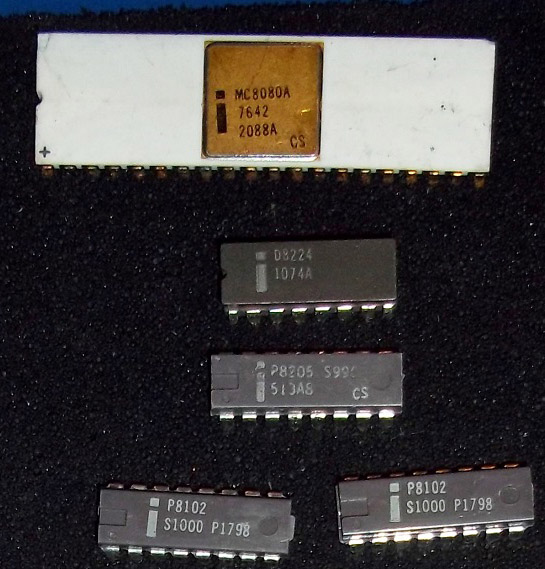
In my daily hunt for new processors, and other chips for the museum, as well as information about new chips, I constantly come across interesting chips, in strange locations.  Here you will get a chance to learn WHERE many of the chips in the museum come from and what they are.

Now Available for sale is The Collector’s Guide to Vintage Intel Microchips, Buy it today at the CPU Shack Museum.

Tags:

Posted in:
Museum News

September 29th, 2011 ~ by admin

Museum update: Several thousand added

Leaving on a trip so I dumped all the pending CPUs/EPROMs etc to a gallery.
There are litterally thousands of new CPU’s, EPROM’s, FPU’s, and some oddities.

They are sorted by manufacturer (technically brand)

You can view them in gallery form here:
http://www.cpushack.com/updated-museum-collection-photos/

You may also view them in raw directory form here:
http://www.cpushack.com/CPU_Photos2/
and a few that didnt make it into the gallery here:
http://www.cpushack.com/CPU_Photos/

Spread this post:
  • Digg
  • Sphinn
  • del.icio.us
  • Facebook
  • Mixx
  • Google Bookmarks
  • DZone
  • Reddit
  • StumbleUpon
  • TwitThis

Posted in:
Museum News

August 2nd, 2011 ~ by admin

30 Years ago today: The IBM 5150 PC

Intel D8088 - 1981 Production

Hard to imagine its been 30 years since IBM released the 5150 Personal Computer for the grand sum of $1265 thus starting the flood of PCs.  Build with generic hardware, and MS-DOS from Bill Gates and crew (itself only released a month prior), the 5150 did away with proprietary, the MS-DOS OS was not exclusive to IBM, and the hardware was essentially off the shelf, using Intel’s 4.77MHz 8088 (cut down version of the 8086) processor and a discrete 256k of RAM.  Other companies, could, and did, in mass, replicate and add to the 5150 making the 8088, and with it the x86 instruction set the de facto standard even to today. (though ARM has been making a large impact as of late due to the rise of mobile computing)

Here is an early add for the 5150, not only have we come a long ways in computers, but advertising as well.

Tags:
,

Spread this post:
  • Digg
  • Sphinn
  • del.icio.us
  • Facebook
  • Mixx
  • Google Bookmarks
  • DZone
  • Reddit
  • StumbleUpon
  • TwitThis
April 25th, 2011 ~ by admin

50 Years ago today: The IC was Patented

On April 25th, 1961 Robert Noyce, then working at Farichild Semiconductor, received Patent 2,981,877 SEMICONDUCTOR DEVICE-AND-LEAD STRUCTURE.  This was the patent for how to make integrated circuits, containing multiple silicon based transistors, on a single die.  Six months prior Jack Kilby received a similar patent, but for geranium based devices.  Silicon became, for a variety of reasons, the preferred material and 50 years later we now use some of the same principles to build IC’s with over a billion transistors on them. The diagram in the patent showed a device with 8 components on a single doe, 1 transistor, 2 diodes, 2 capacitors, and 3 resistors.

In 1968 Noyce, and Gordon Moore (of Moore’s Law fame) left Fairchild and founded Intel. Fairchild Semiconductor was the ‘incubator’ of many such semiconductor companies, Intersil, Teledyne, Xicor and AMD were all founded by former Fairchild employees

Tags:
, ,

Spread this post:
  • Digg
  • Sphinn
  • del.icio.us
  • Facebook
  • Mixx
  • Google Bookmarks
  • DZone
  • Reddit
  • StumbleUpon
  • TwitThis

Posted in:
Museum News

April 21st, 2011 ~ by admin

Inside the 1802: a Visual6502.org View


RCA 1802E Die - 20x magnification - Visual6502.org

The talent at Visual6502.org continues.  After imaging and building a complete simulator for the MOS 6502 they did the same for the Motorola 6800 (from which the 6502 was based).

We have sent Visual6502.org several chips and they have now imaged the RCA 1802 that we sent.  What is very interesting is how little marking are on the die, the only that I could see was the number ’10824.’  This particular chip was dated early 1981 though the 1802 COSMAC was designed in 1976 and was one of the first CMOS microprocessors.  The 1802 had around 5000 transistors (Visual6502 will let us know exactly how many once they are done, and of course what each and every one of them does). For higher res shots and more info see here

Tags:
,

Spread this post:
  • Digg
  • Sphinn
  • del.icio.us
  • Facebook
  • Mixx
  • Google Bookmarks
  • DZone
  • Reddit
  • StumbleUpon
  • TwitThis
April 1st, 2011 ~ by admin

Osborne Computer: The Rise and Fall

Technologizer has published a very interesting article on Osborne Computers, and its founder, Adam Osborne.  Osborne computers was started 30 years ago (April 3rd 1981).  They were the fastest growing, and fastest failing company in Silicon Valley, impressive even today. Adam Osborne was one of the most important people in Silicon Valley (along with Bill Gates and Steve Jobs).  His books in the 70′s are still invaluable resources for collectors, I have several editions of ‘An Introduction to Microcomputers’ which provide an invaluable reference to some of the chip designs of the 1970′s and early 1980′s.

The Osborne 1, the first wildly successful portable, was based on a Zilog Z80A processor and ran the then popular CP/M OS.  If it wasn’t for cash flow problems, Osborne computers may very well have still been making computers today.  It is also interesting that Mr. Osborne had a habit of picking designs that ended up to be not very successful (he chose the Zilog Z8000 and Intel 8089 I/O processor as ‘Chips of the Year’ in 1980)

Tags:
,

Spread this post:
  • Digg
  • Sphinn
  • del.icio.us
  • Facebook
  • Mixx
  • Google Bookmarks
  • DZone
  • Reddit
  • StumbleUpon
  • TwitThis
November 23rd, 2010 ~ by admin

Another Apple 1, Another Quarter Million Dollars

In September a Apple 1 computer with a few accessories sold for $23,000.  Christie’s has just auctioned off an early (first run) Apple 1, with invoice, shipping box, letter from ‘Steven Jobs’ and many accessories for a staggering $213,600.  This would have been one of the original PCB’s, sold without components and later assembled by someone else.  The main CPU is of course a 6502 but in this case a R6502P by Rockwell made in late 1981.

Complete Apple 1

What made this one so much more valuable?  The documentation and original box.  Whoever bought it should however replace the CPU with a white ceramic MOS 6502 to preserve the beauty of the original Apple 1.

Tags:
,

Spread this post:
  • Digg
  • Sphinn
  • del.icio.us
  • Facebook
  • Mixx
  • Google Bookmarks
  • DZone
  • Reddit
  • StumbleUpon
  • TwitThis
October 18th, 2010 ~ by admin

Before the PC, Before Apple, was the Xerox Alto

Xerox Alto-II XM

Just last month an Apple 1 computer sold on eBay for almost $23,000. Today, the father of the PC, and where Steve Jobs got many of his inspirations (as did Bill Gates and numerous other founders of the computer industry), sold on eBay for a bit over $30,000.

The Xerox Alto was really the first modern computer as we know it.  It was developed at the PARC research center, and had Ethernet, a mouse, a GUI, and assorted other things we are rather use to now.  The date? 1973. Xerox did not understand the significance of what they had.  They made over 2000 Altos of various configurations, but never sold them, most were simply given away to friends, workers, and universities.

Though never sold, the Alto’s value in the 1970s was $32,000  or so, not a far cry (disregarding inflation) of what a non-working one just sold for on eBay

The Alto was powered by a custom16-bit bit-slice processor consisting of 4 TTL 74181 ALU’s one of the first uses of the 74181, which was itself the first single chip ALU.

TI SN74S181N - Late 1973 - 90MHz

The 74181 consisted of around 75 gates, and could perform 16 arithmetic functions and 16 logic functions on a pair of 4-bit inputs.  It was, for its time, very fast, much faster then most of the single chip processors of the time.  A 74S181 like shown here, using Schottky technology, could operate at up to 90MHz or so.  Obviously in a computer like the Alto actual clock speed would be reduced to match what the memory could do, which in the Alto, with its 128K of RAM, worked out to 5.8MHz.

Tags:
,

Spread this post:
  • Digg
  • Sphinn
  • del.icio.us
  • Facebook
  • Mixx
  • Google Bookmarks
  • DZone
  • Reddit
  • StumbleUpon
  • TwitThis

Posted in:
Museum News

October 11th, 2010 ~ by admin

Soviet Beauties: Processors from behind the Iron Curtain

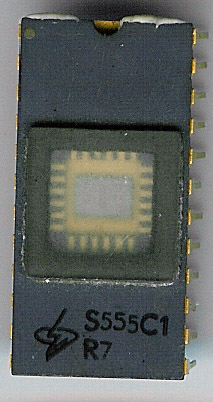
The Soviet Union’s electronic programs were mainly focused on copying and cloning Western devices.  Either by simple theft, or painstaking reverse engineering.  They made clones of devices such as the Intel 8080, and the AMD 2901 as well as simple TTL.  The Soviets also made many single and multi-chip versions of the venerable DEC PDP-11 computer system.  Many of these have no Western analogs, they were pure creations of the Soviet industry.

Soviet Kvantor 580VM80 - Intel 8080 - Milspec

While Western chips rapidly transitioned into mostly black plastic by the 1980s the Soviets did not.  The 8080 above was made in 1991 though looks like something from the 70′s. Black plastic is cheap, and easy to make, but it isn’t great looking. The Soviets on the other hand made some of the best looking (if not always functioning) processors of the time.

Soviet J-11 Missing the chips

Here is just the substrate (its a non finished example) of a Soviet clone of the DEC J-11 CPU. Not often do you see a brilliant blue processor.

Soviet Angstrem K1801VM1

This is a nice pink ceramic Soviet PDP-11 5MHz CPU. Again this was made in 1991.  Its a form of surface mount package that was used extensively for industrial and military designs.  Just as the PDP-11 was used by the American military throughout the 70′s and 80′s. the Soviets used it (and now Russians) in todays times.

Soviet era CPUs are very interesting to collect.  Each state run factory had their own logo which was typically (but not always) put on the chip. Many part numbers were made by more then one factory. Most chips have a western analog, but not all.  Soviet chips also were ever so slightly different sized then Western ones. The Soviets used a pin spacing of 2.5mm where as the West used 0.1″ (2.54″), rather noticeable on a 40 pin DIP. Reading/translating some of the Cyrillic  based characters can be a chore but really when you get to see things like this…

Electronika J-11 - Image courtesy of iguana_kiev

Can you really complain?

Tags:
,

Spread this post:
  • Digg
  • Sphinn
  • del.icio.us
  • Facebook
  • Mixx
  • Google Bookmarks
  • DZone
  • Reddit
  • StumbleUpon
  • TwitThis
September 15th, 2010 ~ by admin

Homebrew Cray-1A – 1976 vs 2010

In 1976 the fasted normal processor ran at around 5MHz (such as the RCA 1802).  Personal computers really hadn’t been thought of, and mainframes were massive.  It was then that Seymour Cray decided to build a Super Computer. A computer that would be better and faster then most anything that existed at the time.

The Cray-1 ran at a blistering 80MHz, and could work with a staggering 32MB of memory.  This performance was not achieved in personal computers until the 1990′s.  No single processor of 1976 could attain these speeds so Cray designed his own.  Only 4 different types of ICs were used in the Cray-1 (2 types of quad-NAND gates and 2 types of SRAM)  All of the logic was ECL (Emitter Coupled Logic) which was very fast, very power hungry, and produced a lot of heat.  In all the Cray-1 used some 200,000 gates, many of which were solely used to add timing delays to make sure signaling did not generate standing waves or switching noise.

Original Cray-1 Circuit Board

Recently a man by the name of Chris Fenton decided to make a 1/10th WORKING scale model of the Cray-1A. This is no small feat, there is not a lot of surviving documentation for the Cray, nor is there much of any software left (they were mostly retired from service by 1990).  Chris wished the Cray-1 to physically look like the Original (including the padded bench seat) as well as be binary code compatible.  His implementation runs at 33MHz on a Xilinx Spartan-3E 1600 CPLD.  Basically this is a dev board with a chip that has a complex array of programmable logic that you can program to do what you want.  In this case 1.6 million gates, about 1.2 Million of which are used in the design, significantly more the the original.

Cray-1A Model

The original Cray weighed in at 5.5 tons with the cooling system, and drew around 30kW of power. The 1/10th scale? will run on a few batteries.  Supercomputers are still an important part of computing, but as vector processing expands (what the Cray was orginally diesgned for)  such things as graphics cards can be used to perform much of the tasks of a supercomputer, and do so faster and cheaper.

Regardless, when people think of a Super Computer, they think of the Cray

Spread this post:
  • Digg
  • Sphinn
  • del.icio.us
  • Facebook
  • Mixx
  • Google Bookmarks
  • DZone
  • Reddit
  • StumbleUpon
  • TwitThis