February 16th, 2009 ~ by admin
CNet Blog nanotech recently did an article about the 3 most recent CPU design flops by Intel, IBM, and AMD.
For Intel they chose the Itanium, and Itanium 2, there is no doubt that the Itanic as it is commonly called was a failure of epic proportions. It cost to much, and ad NO decent backwards compatibility and no existing code base. Intel of course still keeps plugging away on it.
For AMD editor Brooke chose the Puma, AMD’s much hyped and highly underperforming CPU/GPU, no argument here, it was and is a dog.
Where I disagree is the selection of the PowerPC by IBM. While Apple’s use of the PowerPC (all 10 years of it) ultimately ended in failure, the PowerPC did find its niche in many industries. Servers and supercomputers worldwide use thousands of PowerPC CPU’s. IBM has created many embedded versions which are used in everything from industrial control to running printers. IBM has also successfully license the PowerPC architecture to many other companies (over 20 at that, including a couple CPU’s running on Mars). Xilinx makes FPGA’s with multiple integrated PowerPC cores which find there way into about everything. Apple continues to be involved in PowerPC through their purchase of PA Semiconductor.
Perhaps the most well known users of the PowerPC today? The Nintendo Wii and the XBOX 360.
February 14th, 2009 ~ by admin
National Semiconductors COP8 family of microcontrollers has been around for many years now, and with over a billion shipped, in thousands of configurations, will be around for quite some time.
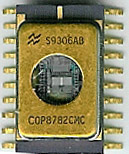
COP8782CMC
This is a rather unusual COP8 used for development purposes. This is the first SOIC I have seen in ceramic, let alone with the UV Window.
February 11th, 2009 ~ by admin
Today two of the leading chip design companies for mobiles phones, media players, and other ‘connected’ devices merged. SiRF, widely known for their advanced low power GPS receivers and CSR, makers of some of the most widely used Bluetooth devices in the world.
CSR’s BlueCore line of chips integrate a XA-RISC controller, while SiRF’s latest offerings use an ARM7 core. The merger will allow them to build a single chip solution with wifi, bluetooth, and GPS, a device that is likely to find itself in about every connected device you can imagine. It will be interesting to see which processing core they stick with, though it is likely the final products will end up with both.
Source: SiRF Press Release
February 11th, 2009 ~ by admin
Electronic Arrays was born in the late 60’s back in the time of many start-ups (which mostly trace their roots back to Fairchild) EA attempted to make a CPU called the EA9002, but production problems kept them from going anywhere with it. They made EPROM’s likely to keep them afloat (and only 8k ones at that).
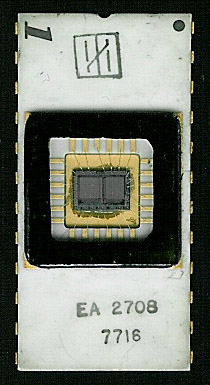
Electronic Arrays 2708
This EPROM was made in early 1977, less then a year later EA was bought out by NEC, now a world leader in electronics.
February 8th, 2009 ~ by admin
Last week we talked about Software Configurable Processors, and how they bridge the gap between general purpose CPU’s and FPGA’s. Yesterday a pair of them came in the mail.

Stretch S6000 & S6106
The S6100 is Stretch’s flagship product at this point (4 data ports full AIM interface and PCIe running at 345MHz). The S6106 is the low power device (2 data ports no AIM and no PCIe, clocked at 167MHz). This particular S6106 is an Engineering Sample. They are both based on the Xtensa VLIW core. (pic after the break)
Read More »
February 6th, 2009 ~ by admin
NEC has just announced one of the smalled ARM processors you will see. As mobile phones are getting more and more complex, more and better features are being added. In a smart phone such as the Blackberry Storm, or the iPhone, it is not uncommon to have 3 or 4 (or more) ARM cores in the design. NEC just added another. The new NEC CE143 is meant for one thing, running the camera on your phone. Most phone cameras have a 2 or so megapixel cam on them, some are heading towards 8+. The CE143 is meant for 12 megapixel cameras, and can record full 1080p HD video, on your phone. Check out the size of this:

NEC CE143 ARM mobile image processor
Tiny is right and that package includes 64MB of RAM and a MB of Flash
February 4th, 2009 ~ by admin
So I bought some chips on eBay, they arrived, and are New Old Stock, made in 2004, really fairly recent. I have a datasheet for them that is marked Winbond which I found rather strange, since the chips, as you can see are marked National. This in itself isn’t super unusual. Occasionally a smaller company will use a larger companies markings to get design wins. The larger company acts in essance like a co-signer, validating and approving of the design.

National PC97551
Winbond isn’t small though, and the datasheet was marked 2006. A quick look on Winbond’s site shows no info on this chip. Turns out Winbond spun off their controller business to a company called Nuvoton. And how did Winbond get the desgin? Yup, National sold off their Super I/O and embedded controller division to Winbond in 2005.
And it is of course a processor, in this case a 16bit RISC processor running at 20MHz based on the (formerly) National CompactRISC architecture.
February 3rd, 2009 ~ by admin
When designing a system, the best performance is often reached by using an ASIC, you can customize it to your design and tweak it for maximum performance. This, however, adds costly development time, and little flexiblility. You could use a general purpose processor; this saves dev time, and cost, but at the expense of performance. What if you could have both? Off the shelf processor technology, AND customizable speed.
You can. This is what Software Configurable Processors are designed for. In simple terms they are a standard CPU core, wrapped in a FPGA. This way istructions for the processort can be configured for maximun speed. If you have a function in your code that is repetitive, it can be reduced to a single instruction for the processor.

One of the leaders in Software Configurable Processors is called Stretch. Their S6000 line of processors use a Tensilica Xtensa core (a VLIW RISC design), wrapped in a custom FPGA. In this way the RISC core can be programmaed on the fly, providing much faster performance then a normal processor, or DSP.
February 2nd, 2009 ~ by admin
Back in the day of CPU’s National was on the forefront of CPU design, while Intel was messing around with 4 and 8 bit designs. It by itself was the 4th CPU, and the 1st bit slice device.
It consists of:
4 x 4 bit IMP-00A/520D – These are the Register and Arithmetic Units
1 x IMP16A-521D – Standard 16 bit Instruction set control chip (Based on the Data General Nova)
1 x IMP16A-522D – Extended 16 bit Instruction set (not sure what addition instructions it has)
These were sold in a set by National, and in a pretty nice box.

National IMP16A-500D
Later on National implemented them as a single chip, the IMP16A-500D PACE, and then the NMOS INS8900.
More infomation about the IMP16 can be found at Antique Tech
January 30th, 2009 ~ by admin
As I am sure everyone has seen, the semiconductor industry is far from immune to the current economic recession (dare I say depression. Analysts are now saying the 2009 chip market will falls from 20-30%, and suppliers (wafers, imaging, scanners, mask sets etc) will be down over 40%.
The chip market will likely rebound some in 2010, but mainly correcting from overcautios cuts this year (we hope). The interesting part is the difference in cuts from chip makers, to their equipment suppliers. What this typically means is that semiconductor companies expect to continue using their existing equipment, ie no process improvements/shrinks any time soon. This helps avoid large capital costs, while preserving some revenue stream.
In other news, there will be A LOT of excess fab space this year.