May 10th, 2009 ~ by admin
Most companies saw dismal results in the 1Q of ’09. April however has seens a few rises. Both TSMC, and UMC saw increased sales, partly due to the Chinese stimulus package, and likely due in part to the release of the Kindle 2. Is it economic downturn over? Not likely, but at least there has been some shining lights amongst it.
May 3rd, 2009 ~ by admin
IEEE Sprectrum has a neat article detailing 25 microchips that fundamentally changed the IC business (or could have). Some of them are as simple as the 555 timer chips, whose 23 transistors were used, and continue to be used in millions of projects. Some of the processors that made the list are the MOS 6502, Intel 8088 (of course) as well as the SPARC, and Acorn ARM.
May 1st, 2009 ~ by admin
There has been rumors flying a lot lately about Microsoft possibly making a version of Windows 7 available to run on ARM based processors. Intel obviously is very much against this happening, which is why it NEEDS to happen. The current CPU market is starting to get stale. Intel has around 80% marketshare, and AMD is struggling to compete. This does not lead to innovation on the scale we saw back in the 90’s when there were several processor companies making Windows compatible chips.
Currently the #1 processor for mobile devices is ARM (in its many flavors), It powers the iPhone, the Palm Pre, many Blackberries and hundreds of others. ARM processors run OS X, Android, PalmOS, and Windows Mobile (as well as Windows CE). We now are seeing growth in a new segment, Netbooks, and soon to be tablets. There are several of these that are ARM based and run flavors of linux, but the vast majority use Intel Atom CPU’s and run Windows XP.
ARM processors, clock for clock, are more powerful, and more efficient then the Intel Atom. Windows 7 running on ARM processors would open up vast new oppurtunities in the netbook/MID class of devices both in software, and hardware. And perhaps more importantly it would force both AMD,and Intel to compete with better and more innovative products. Intel would need to shift some of its focus away from AMD, and into competing with ARM, allowing AMD to grow as well. ARM licensing scheme would also allow us to break away from the choke hold that Intel currently holds on the x86 style architecture.
The end result? More speed, features, and efficiency for the consumer, and a much more stable processor industry.
April 26th, 2009 ~ by admin
Often times its easier, and cheaper to break a big job down into smaller more manageable chunks. The same goes for processing, and back in the 70’s and 80’s was fairly common. ‘Wider’ processors were available, but were expensive and often not very flexible. Bit slice processors were invented to fix this. a BSP is essentially an ALU (Arithmetic Logic Unit) that was 2 or 4 bits wide. They could be put in parallel though to make processors of any width you needed. intructions and control would then be fed to them by a control/sequencer chip. Perhaps the most famous was the AMD 2901, a 4 bit slice device which is still in production today by companies like Innovasic.
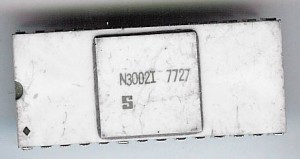
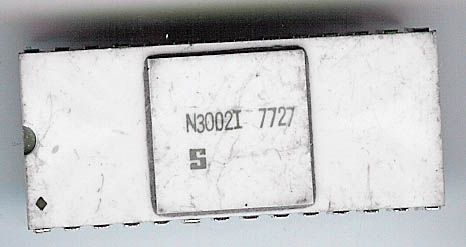
Signetics 3002 BSP
Intel also made a BSP, called the 3002. It was 2-bit slice processor and was second sourced by Signetics, as well as Intersil. Released in September of 1974, it was clocked at 6MHz, very fast for the time, and another reason BSP’s were so popular. Above is a Signetics made 3002 in an all white ceramic package. Fairly unusual in that the lid is also white.
April 22nd, 2009 ~ by admin
Amazon’s Kindle 2 e-book has been a pretty big success. What many do not know is the amount of processing power in it. The main processor is a Freescale MCIMX31LVKN5C Applications processor, which is based on a 532MHz ARM11 core (yes it is faster then an iPhone). The Wireless connectivity is provided by a Qualcomm MSM6801A baseband processor, which at its heart is a 200MHz ARM9 core. Also included in it is 2GB of Samsung moviNAND which is flash memory, with the controller (itself a processor) built in. The electrophoretic bistable display uses a controller made by E-ink and Epson, which of course contains a microcontroller.
In modern electronics the question is not “Does it have a processor?”, but rather “How many processor cores does it have?”
April 12th, 2009 ~ by admin
Performing your banking with an unsecured connection, or surfing the web without a anti-virus is dangerous to say the best. Your data may become compromised which of course could serious ruin your day. These problems extend to the hardware level as well. In such things as your microwave, their is software running on the hardware to control it. It would be possible to extract this software code given the right tools. Stealing kitchen appliance code is not a particular threat obviously. However, there ARE applications where the software running on a set of hardware IS very important, more so often then the hardware itself. Take for example the battlefield management software on a tank, or the flight control system on a F-22A Raptor. This is not something you want someone to be able to recover.
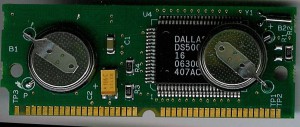
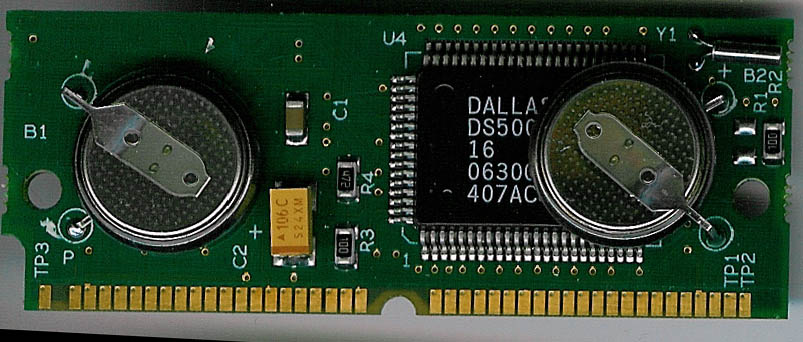
Dallas Maxim DS2252T-128-16
Several companies make what are called ‘Secure Processors.’ These are processors designed to keep the code on them VERY secure. Above is one from Maxim, tamper with it, and the SRAM is auto erased to all 0’s rendering the code useless. It has encrypted data buses, on-board AES encryption, random key generators, the works.
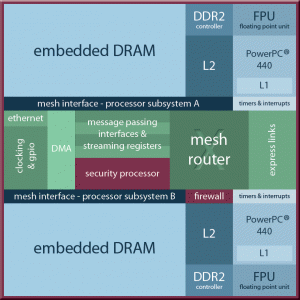
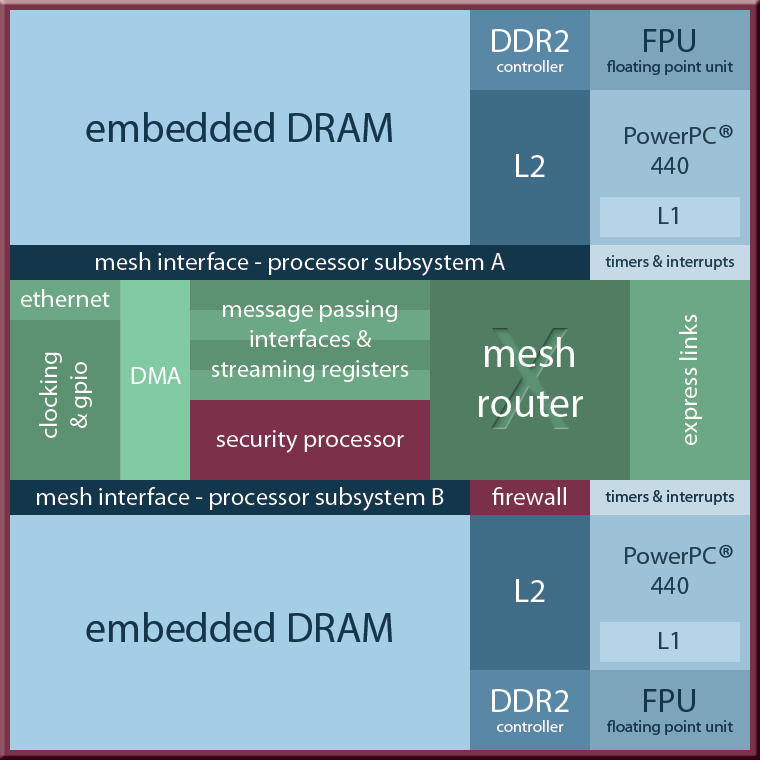
CPU Technology CPU872 Acalis
A Company called CPU Tech has a processor called the CPU872, which is now available for commercial use (previous designs have been DoD only). Programs are securely booted from encrypted flash and decrypted onto on-chip embedded DRAM, and neither cleartext nor the decryption key is ever accessible, according to CPU Tech. In a multi-processor system, all I/O communication between CPU872 devices is also secured, according to the firm. This processor includes 8MB of onboard DRAM, as well as a pair of 800MHz PowerPC 440 cores. The security however doesn’t start at the chip; CPU Tech only uses ‘Trusted Foundaries’ in the manufacture of their parts, to ensure malicious hardware is not added to the part during fabbing.
April 10th, 2009 ~ by admin
A computer or device used in ones home has a pretty easy life. The temperature ranges are fairly conservative, and there isn’t constant vibrations. In addition, sitting in your home, you are not being bombarded with radiation (thankfully). However some computers are designed to be used in places where they are under such stresses. For example, in space based systems such as satellites.
Special CPU’s are made and tested for these applications, they have to be able to be exposed to radiation with having ‘soft errors’ and they have to work in extreme temperature ranges. -55C-125C is the standard military temperature range for such processors.
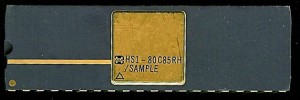
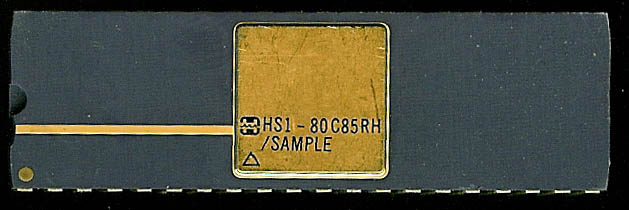
Harris HS1-80C85RH/SAMPLE
Here is a 8085 processor made by Harris Semiconductor (now Intersil). It is a sample of a device that would be used in such environments. A fully qualified chip would cost many thousands of dollars typically. This is because all of the time consuming tests that have to be done (including many devices that must be destroyed in testing).
April 8th, 2009 ~ by admin
Intel who we know as a CPU company, actually got its start, and most of its revenue, by making EPROM’s (Electrically Programmable Read Only Memory). EPROM’s were actually Intel’s most profitable product line through 1985.
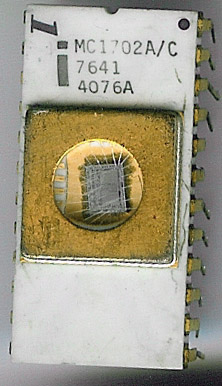
Intel MC1702A/C EPROM
The 1702A was introduced in late 1972, it holds all of 256bytes. (2048 bits). This particular device is MIL-STD-883 Class C compliant (Class C no longer is used today). It had to undergo much more testing and process control then a regular commercial device, as well as work in higher/lower temperatures. This particular part was made in late 1976. Sadly it has a couple missing pins, but for being 32 years old is not bad.
April 6th, 2009 ~ by admin
A quake struck Italy last night killing around 100. The CPU Shack Museum wishes the best for all involved. There are many great CPU collectors in Italy and we hope that them, their friends, and families are all OK. If there are any needs, feel free to contact us, and we will attempt to help where we can.
April 4th, 2009 ~ by admin
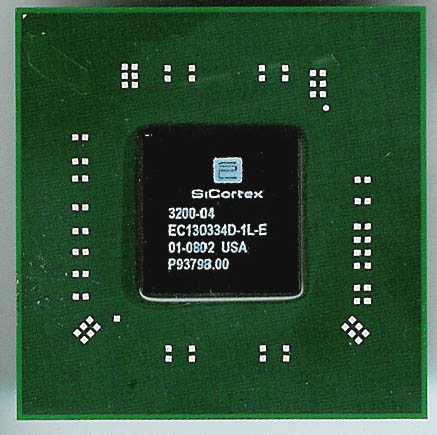
SiCortex is a supercomputer company, or as they are called today ‘High Performance Computers’ (HPCs). HPCs have traditionally taken vast amounts of room, and vast amounts of power. SiCortex has changed that. Their fastest offers 5,832 1.4GFlops 64-bit processors, each dissipating just 900 milliwatts of power. All interprocessor communications logic plus two DDR-2 memory controllers and PCI Express I/O logic are on the same node chip with the multiple processor cores. Complete with its 8 Terabytes of system memory, the SC5832 fits in a single cabinet and only requires around 20 kilowatts of wall power.
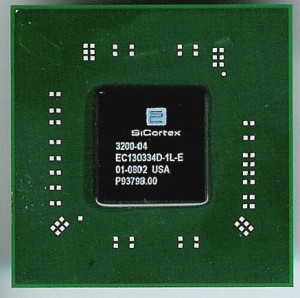
SiCortex Node chip
These nodes, shown above, each contain 6 MIPS64 cores running at 700MHz, a pair of DDR2 memory controllers, gigabit ethernet, an 8xPCI Express controller, and 256k of L2 Cache, quite impressive.
Much thanks to SiCortex for donating this node chip to the museum.