March 16th, 2010 ~ by admin
Earlier we talked about why old designs are not going away. Today lets look at a new design. The Intel Corei7-980X Extreme. Currently one of the most powerful processors in existence. For comparisons sake I am going to loosely compare the 980X to the Motorola 68000 which arguably was the first 32 bit CPU. (yes the 980x is technically 64 bit but for the sake of comparison we’ll use it).
|
Core i7 980X |
Motorola MC68000 |
| Speed |
3600MHz |
4MHz |
| Transistors |
1.17 Billion |
40,000 |
| Process |
0.032 micron |
3.5 micron |
| Power |
130W |
1.35W |
| Voltage |
0.95V |
5V |
| Cost |
$999 |
~$30 |
Too put that in perspective you could stick over 29,000 MC68K cores on a 980X die.
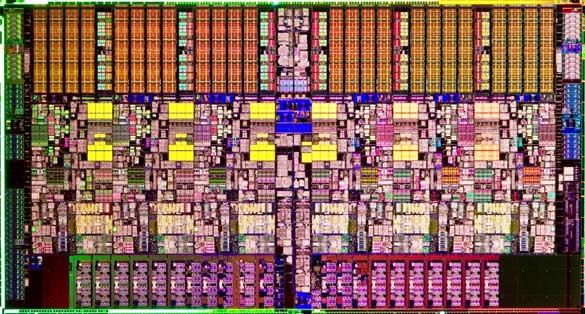
Intel Core i7-980X Processor die
So while old designs are still in wide use (and will continue to be) the new processors are nothing short of amazing.
980G Review may be found here at Hot Hardware
March 14th, 2010 ~ by admin
This topic comes up a lot. Why are old CPU designs still used? and used a lot. Every few years a company will make a statement about their new 32bit or 16bit CPU/MCU design that makes ‘migration from an 8-bit design easy’ or seeks to replace 8-bit microcontrollers entirely. It does not happen, and will not for decades.
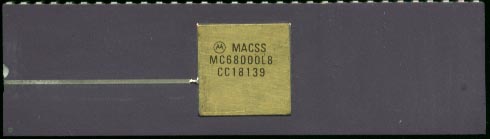
1981 Motorola 68000 a 16/32bit CPU
8-bit processors first debuted in 1972 with the Intel 8008, so they are pushing 40 years. What many don’t realize is that 32bit processors debuted in 1979 (Motorola 68k and National Semiconductor 32k). So 32 bit is nothing new, and the same reason applies today as it did 30 years ago. Why use a Ferrari when a Chevy will do? Most designs simply don’t need that power, or complexity, 8-bits is MORE then enough to run a toaster oven, a bread machine, or your TV remote.
Embedded.com had an article talking about this issue just last week. So why do companies say that their design will replace 8-bit? It’s good PR, it gets people talking about their new processor, and thats not a bad thing.
March 6th, 2010 ~ by admin
One thing we talk a lot about is power budgets, getting as much performance out of a chip, with the least power draw possible. There is of course other budgets, such as space, or one we all know, cost.
When you buy a new Intel Core i7 processor you expect to spend $300 or so. Its common the CPU’s in phones etc cost $10-$20 each. However many applications don’t need or cannot afford that much power. In fact, most CPUs are NOT vastly powerful, or expensive. For example ST just annoucned a ARM Cortex-M3 based 32bit CPU, running at 24MHz, its cost? $0.85. TI has a whole line of its popular MSP430 16bit microcontrollers, running at up to 25MHz, they cost $0.25, yup less then a pack of gum for a fully featured processor.
March 6th, 2010 ~ by admin
 There is no denying that e-readers are a cool piece of technology. One of the things that makes them so interesting, and popular, is the unique e-ink display. A bi-stable display that only needs power to CHANGE what it is showing. These displays use VERY little power since they only need to update content ever few minutes when say reading a book on them.
They do however require a controller to make them work, which is a seperate chip, and cost for an e-reader. A kindle, or Nook is certainly nice, but the cost is prohibitive to many.
Enter Freescale, they have developed the i.MX508 system-on-chip (SoC) combines a hardware Vizplex controller (e-ink controller) with a fast ARM Cortex-A8 applications processor and special e-reader power-savings modes.
End game? $99 E-readers, that will change the market
Source: EE Times
February 13th, 2010 ~ by admin
The new server runs IIS7, which has rewrite built in. there was an issue with this, permalink (WordPress) and some old IE6 support in the CSS file, this caused the site to not work correctly in all versions of IE.
We apologize for the down time.
February 11th, 2010 ~ by admin
Seems this picture is making its rounds:
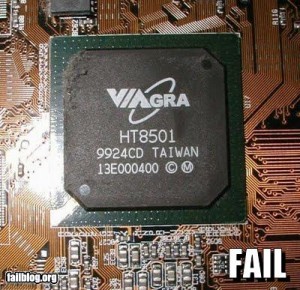
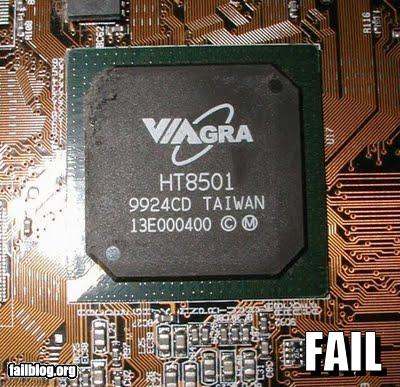
VIA HT8501
It is a VIA HT8501/VT8501 North Bridge, used on Socket 7 systems. It included Trident Blade 3D Graphics
Commonly known as the Apollo MVP4 Chipset. I suppose it adds new meaning to integrated Trident Blade. Its no wonder VIA didnt use this branding for long lol. If your system stays up for more then 4 hours….
February 6th, 2010 ~ by admin
The old server was getting a bit long in the tooth (an old Athlon 64 X2 4200+, 2.2GHz 1MB L2 cache) so we have transitioned The CPU SHack to a new and better server. It is an Intel Core 2 Duo E8400 3GHz dual core CPU with 6MB of L2 cache.
It should be a bit speedier.
February 1st, 2010 ~ by admin
Much buzz and attention has been given to the Apple iPad, while the jury may still be out as to what Apples tablet is or isn’t useful for, one thing is true, it packs apples first self-branded processor. Apple touted the processor of the iPad as a new creation and the most advanced yet, which is a bit of a stretch.
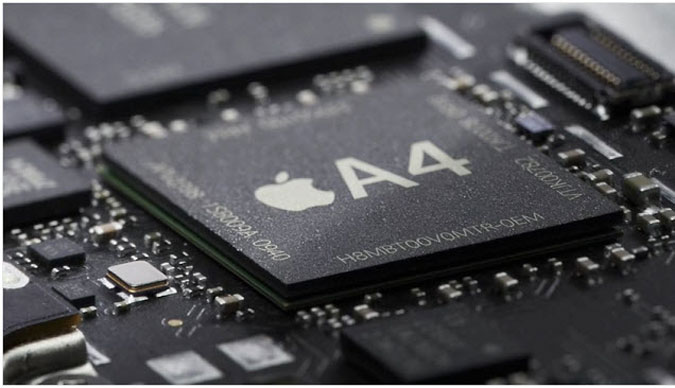
Apple A4
The Apple A4 is a ARM Cortex-A9 based SoC, it uses the ARM Mali graphics core (which is fairly robust). It was Created by P.A. Semiconductor who Apple purchased a couple years back. P.A. use to be a PowerPC company, apparently not any more. It makes sense for Apple to use an ARM based processor in the iPad as that is what powers the iPhone and iPod. The Mali graphics core is a bit of a mystery, as Apple holds a license to its competitor, made by PowerVR, and alas the iPhone uses a PowerVR core and not a Mali core.
Essentially the Apple A4 (based on what we currently know about it) is an off the shelf design. It is not any thing revolutionary, or in fact new at all. The Nvidia Tegra 2 is also a 1GHz ARM Cortex-A9 processor. TI has a 1GHz OMAP, Qualcomm the 1GHz Snapdragon (soon to be 1.5GHz), ST has the Nomadic, and Marvel has a 1.2GHz ARM.
Perhaps then, the iPad is a ‘version 2’ product, much like the very first iPhone, Apple has lots of room to make it better, to make it outperform, and not merely match the competition. Time will tell.
UPDATE: It has been confirmed that the A4 uses PowerVR graphic (same as the iPhone) and not a Cortex-A9 but a older Cortex-A8. An even less revolutionary design. I would imagine the work APple did on the A4 involved disabling/removing various features not needed by the iPad in order to cut the power consumption even more.
January 14th, 2010 ~ by admin
The Nvidia Tegra series of processors 9really SoCs as they integrate memory controller, I/O bridges, etc all on one chip) just keeps getting bigger and better.

Tegra Processor
The new Tegra 2 announced at CES 2010 now integrates a dual core ARM Cortex-A9 running at up to 1GHz. That’s all well and dandy but it doesn’t stop there. Nvidia also adds separate processor units for HD encoding, still image processing, audio, 2d/3D, HD playback and mobile phone baseband functions. Each core can be independently clocked, throttled, or turned off as needed, resulting in a processor that can run at 500mW.
This is the type of processor you will be seeing in devices like the forthcoming Apple tablet, and future smart phones. All this again begs the question: When will Microsoft port Windows 7 to ARM?
More Info here
January 14th, 2010 ~ by admin
EETimes has another article about a person being charged/convicted of selling counterfeit chips to the US navy. This has been a growing problem in the electronics industry for the last decade, but has its roots much earlier then that.
It was common in the 90’s for counterfeiters (aka remarkers) to take a processor, wipe the markings, and mark it with a higher speed. This was rather common with the Pentium era and newer, but occurred with 486’s as well. To a computer user this typically meant that their computer ran much warmer, and often times less stable.
To a collector this means you must be VERY careful when looking at processors in your museum to ensure that rare sample you have, is not in fact a clever forgery, or that Pentium 133 is not in fact a remarked 75.
Having your computer crash or having a few fake CPUs in your collection is a mere annoyance, but what about actual use? For example a part listed as mil-spec, with a wide temperature operating band, that controls a ships defensive systems? If this is in fact a fake (remarked from a commercial spec IC, which has been happening). The system could and likely WILL fail at the worst time. The result? People lose their lives.