

The Forgotten Ones: Actron AM1608 16-bit CPU.
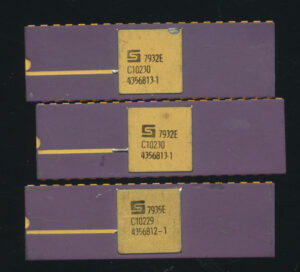
AM1608 Chipset – 1979 – Synertek
Back in 1974 the US Air Force saw the beginnings of a problem as the switch to digital microprocessor controls took over. “Fearful of being stuck with many unique systems requiring extensive software and hardware
support, the Air Force Aeronautical Systems Division (ASD) wants a standard device that could be applied across the board.” Sounds Familiar? (this same problem is what ended up leading to the MIL-STD-1750A processor indirectly). At the time though, this was an AIr Force only project (other branches of course had their own). The USAF called their ‘standard’ the UDAM, for Universal Digital Avionics Module. Like the 1750A, it was to be a standard, not an architecture, companies could create whatever architecture they wanted, however they wanted, as long as it met the standard. McDonnell Douglas (MD), at the time a huge contractor for the Air Force (as well as civilian airplanes) decided to make an entry. MD had a captive company since 1972 called Nitron to manufacture any semiconductors that MD needed for their various planes etc. Nitron was famous for their work on memory (notably EAROMs) but they could make most anything. MD also had another division called Actron (in Monrovia CA) , Actron designed boards and chips for MD, and then Nitron fab’d them. Convoluted, but such is the nature of such large organizations.
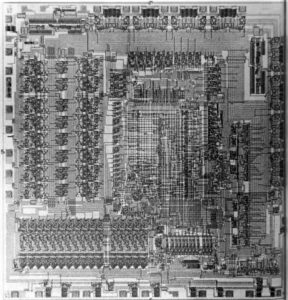
Control Chip DIe – AM1608 – Should be Nitron production.
The design Actron came up with went into production in early 1975 as the AM1608 at Nitron’s fab in Cupertino California. It was a 16-bit design (which was the requirement) implemented in 3-chips. There was a control chip, and a pair of identical 8-bit arithmetic chips. Essentially a bit-slice design, as was fairly common in the 1970’s. The AM1608 had a fixed 16-bit instruction length but data words could be used from 8-80 bits. Actron hoped they could use/sell this design for more than just the Air Force UDAM project.
The chips were initially fab’d on a 5-micron NMOS process with the control chip having ~4413 transistors on a 25mm2 die. Details on the arithmetic chip are unknown. They could execute around 200,000 instructions per second at a 2-2.5MHz clock (all benchmarks I have seen are at 2MHz so thats likely where is stayed) and had 250 instructions available (quite a lot for the time). ADD/SUB took around 0.8 microseconds with a worst case MULT instruction taking 6.8 microseconds. These processors’ were designed primarily for math, similar to the GA-16 from General Automations. Each 16-bit processor could address 8k 16 bit words of instruction ROM. It was expected that the design would move to a silicon gate CMOS process which would double its speed.
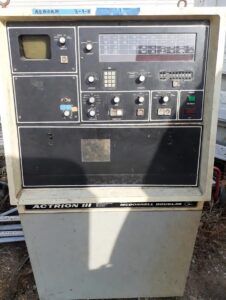
Actrion III 3-axis CNC machine made by McDonnell Douglas.
The UDAM project never went too far but the AM1608 did find some uses outside of it. It was used extensively in universities and military projects for early digital mapping and terrain mapping/following applications owing to its good performance at math, and easy adaptability to different instruction sets. . MD decided to use it for their own brand new CNC machine called the Actrion III. The Actrion III, designed by Actron (because thats not confusing) was named the Actrion III not because it was the third design, but because it was a 3-axis numerically controlled machine.
Each axis was controlled by a separate AM1608 processor system, and the system could be expanded to 5-axis. This machine was sold outside of MD but they did not support it particularly well so was not a well loved machine. It did play an integral part in the making of many of the airliners of the day, such as the and DC-9/MD-80. Making the AM1608 though became a problem….
In 1977 MD sold off Nitron to Nanon Electronics (also in Cupertino) yet still needed to make AM1608 chipsets. For unknown reasons (perhaps they DID get things switched to CMOS) Nitron/Nanon were unable to continue production and the design was sent to Synertek in Santa Clara, CA.
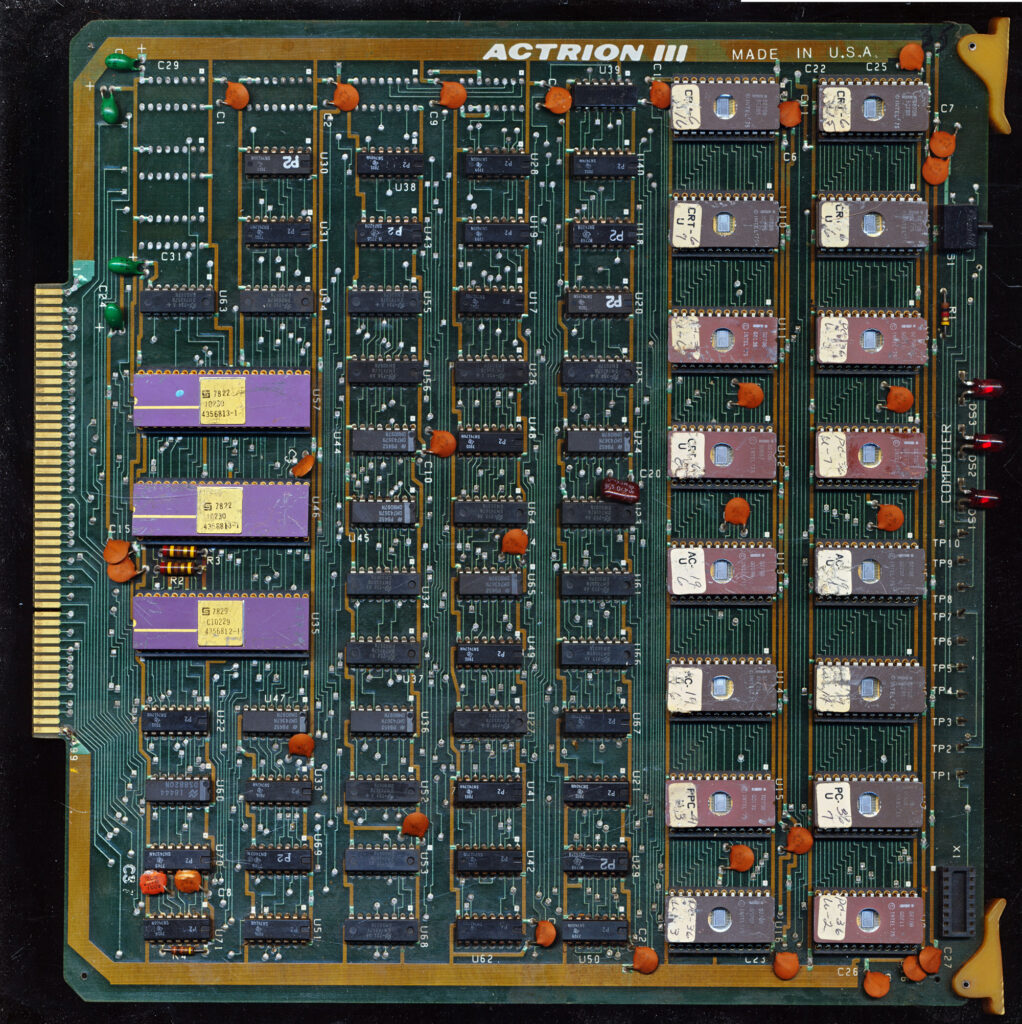
Actrion III – Control board with complete AM1608 chipset dated 1978 and 16 2708 EPROMs.
Synertek began making the AM1608 in 1978 and continued through at least 1979. Synertek part #s were C10229 / 4356812-1 for the Control chip and C10230 / 4356813-1 for the pair of data chips.