
Archive for the 'Processor Manufacturers' Category

April 22nd, 2010 ~ by admin

Apple rumored to buy ARM Holdings

AppleInsider has a post up about a potential interest Apple has in ARM Holdings, designers of the ARM processor cores used in the iPod, iPhone, and iPad, among tens of thousands of other devices. Apple has a market cap, of almost $250 billion, while ARM is just shy of $2 billion. Apple clearly has the cash abilty to purchase ARM outright, and they certainly have a reason to want to.

However, the rest of the computer world has an even bigger reason to keep Apple from doing so.  ARM devices are used by tens of thousands of devices, made by thousands of companies. Silicon containing ARM IP is made by hundreds of companies across the world. The success of these companies, their designs, and the devices they power is in large part based on fair, equal, and predictable availability of licenses from ARM.

If Apple were to own ARM, they could completely stop the availability of licenses to any design they felt was a competitor, or they could delay the release to third parties of newer designs. This is similar to the problem some phone companies are experiencing with Google and their Android OS, Google is motivated to sell their own branded Nexus One phone, with the latest version of Android, before giving the same version to third parties.

Read More »

Tags:
,

Spread this post:
  • Digg
  • Sphinn
  • del.icio.us
  • Facebook
  • Mixx
  • Google Bookmarks
  • DZone
  • Reddit
  • StumbleUpon
  • TwitThis
April 5th, 2010 ~ by admin

Apple iPad Round up: Inside and Out The Processors of Apple’s Latest

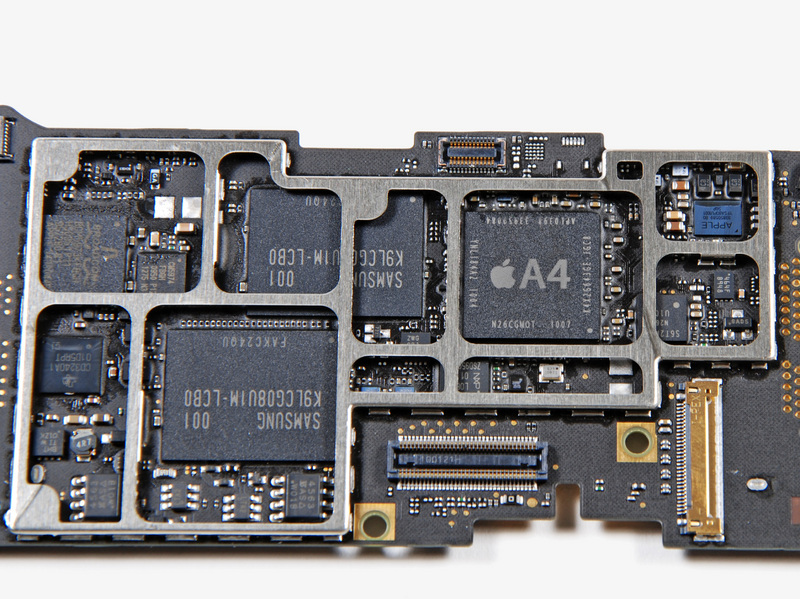
Apple Officially has launched the iPad, essentially a scaled up iPhone, and judging by the model number, it started development several years ago around the time of the first iPod Touch. Many of the components are similar to the iPhone, if not the same. Obviously the biggest processor ews is the Apple A4 ARM processor at its heart. Its developed by Apple, and built by Samsung. a multi-die package, it includes the ARM processor, and PowerVR Graphics on one die, and then two 128MB DRAM dies as well.

iPad Motherboard - A4 CPU by Samsung

What is interesting about the A4? It has a 64bit memory bus, rather then the more standard 32bit but found on most ARM devices. This likely for faster memory access to support faster graphics.

Wifi, Bluetooth, and FM functions are handled by a Broadcom BCM4329 which includes two processors of its own (the documentation of this part does not state what architecture they are, but MIPS or XA-RISC is likely)

The screen controller is the Broadcom BCM5973/5974 which has been used by Apple for several years. The Baseband processor in the 3G version is the Infineon X-Gold 608 which contains a 312MHz ARM926 processor, a 2007 design, so probably saved Apple some money.

So all told the iPad 3G contains at least 4 seperate processors.

Instrinsity: ARM Processor Design House

In related news rumors are flying about Apple acquiring Intrinsity. Instrinsity is a processor design house which specializes in, you guessed it, ARM processors. Its likely they have helped Apple more on the A4 then P.A. Semi (another Apple acquisition) This is further supported by the fact that Intrinsity has worked a lot lately with Samsung in developing a 1GHz ARM CPU (the Hummingbird). Who fab’s the A4? Yah, Samsung.

Sources:
EE Times: Inside the iPad
EE TImes: Inside the iPad: Broadcom/Samsung
iFixit: Teardown
ars technica: Apple buys Instrinsity

Tags:
, , ,

Spread this post:
  • Digg
  • Sphinn
  • del.icio.us
  • Facebook
  • Mixx
  • Google Bookmarks
  • DZone
  • Reddit
  • StumbleUpon
  • TwitThis
March 26th, 2010 ~ by admin

The processors of the Internet – Keeping the data flowing

Routing internet traffic takes a vast amount of processing power. Gone are the days of dialup, where data could be processed with relative ease. Now with every connection pumping out data at rates measured in Mbits, high end devices are needed to route, inspect, and shape that traffic. These devices literally inspect, and operate on EVERY packet that goes through them, that require incredible speed to do so without affecting the speed of the data.

Netronome NFP-32xx block diagram

Enter such companies as Netronome, a maker of network flow processors, compatible with the Intel IXP28xx series. Each one of these processors has a 700MHz ARM CPU, as well as 8 1.4GHz RISC based Microengines are capable of delivering 56700MIPS. Expect to see more such products as companies work to meet President Obama’s National Broadband Plan.

Spread this post:
  • Digg
  • Sphinn
  • del.icio.us
  • Facebook
  • Mixx
  • Google Bookmarks
  • DZone
  • Reddit
  • StumbleUpon
  • TwitThis
March 14th, 2010 ~ by admin

The 8-bit Legacy: Why They will never die

This topic comes up a lot. Why are old CPU designs still used? and used a lot. Every few years a company will make a statement about their new 32bit or 16bit CPU/MCU design that makes ‘migration from an 8-bit design easy’ or seeks to replace 8-bit microcontrollers entirely. It does not happen, and will not for decades.

1981 Motorola 68000 a 16/32bit CPU

8-bit processors first debuted in 1972 with the Intel 8008, so they are pushing 40 years. What many don’t realize is that 32bit processors debuted in 1979 (Motorola 68k and National Semiconductor 32k). So 32 bit is nothing new, and the same reason applies today as it did 30 years ago. Why use a Ferrari when a Chevy will do? Most designs simply don’t need that power, or complexity, 8-bits is MORE then enough to run a toaster oven, a bread machine, or your TV remote.

Embedded.com had an article talking about this issue just last week. So why do companies say that their design will replace 8-bit? It’s good PR, it gets people talking about their new processor, and thats not a bad thing.

Spread this post:
  • Digg
  • Sphinn
  • del.icio.us
  • Facebook
  • Mixx
  • Google Bookmarks
  • DZone
  • Reddit
  • StumbleUpon
  • TwitThis
October 7th, 2009 ~ by admin

ARM and MIPS – The RISC Brothers

Perhaps 2 of the most famous RISC architectures, ARM, and MIPS, have been around for years.  Like many well designed architectures, they continue to be adapted, enhanced, and used in litterally billions of devices.

Recently Altera (maker of FPGAs and CPLD’s) licensed the use of the MIPS32 core.  This is a first for MIPS, as they now join ARM, and PowerPC as major cores available in FPGAs. Source: EETimes

On the topic of ARM, they have been working extensively recently with GlobalFoundries to provide customers with proven IP, specifically the ARM Cortex-A9.  They are developing as a SoC core on a 28nm process.  ARM currently works with TSMC to test, and prove various cores on TSMC’s process, and now will do so with GlobalFoundries. What this does in enable system builders to have IP blocks that are PROVEN on a given manufacturing node. It takes some of the guess work, and certainly risk, out of developing a ASSP, ASIC, or SoC.

Spread this post:
  • Digg
  • Sphinn
  • del.icio.us
  • Facebook
  • Mixx
  • Google Bookmarks
  • DZone
  • Reddit
  • StumbleUpon
  • TwitThis
September 25th, 2009 ~ by admin

(MMitsubishi + Hitachi = Renesas) + NEC = Renesas

Yah a bit of merger madness, NEC Electronics has merged with Renesas, further consolidating the Japanese microcontroller market. This will put the new company third in global IC sales, behind only Intel and Samsung.  It will be interesting to see which products survive the merger, as there will be some overlap.

What does this mean for CPU collectors? Just as happened when Mitsubishi and Hitachi merged, deprecated and eliminated devices will become increasingly hard to find data on.

Source: EE Times

Tags:
, ,

Spread this post:
  • Digg
  • Sphinn
  • del.icio.us
  • Facebook
  • Mixx
  • Google Bookmarks
  • DZone
  • Reddit
  • StumbleUpon
  • TwitThis
September 16th, 2009 ~ by admin

GlobalFoundries + Chartered = a new kid on the block

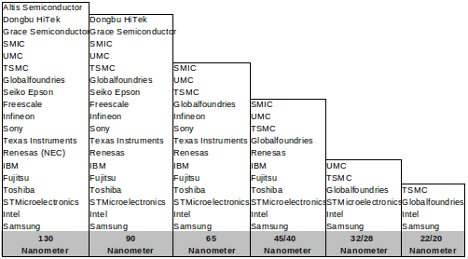
In case you missed it last week, GlobalFoundries (the company AMD spun off to manage its foundries) has acquired Chartered Semiconductor in Singapore.  This changes the playing field a lot in the foundry world.  A world dominated by UMC and TSMC.

Acquiring Chartered allows GlobalFoundries to dissolve some of AMDs interest in the company, as well as bring on board many more customers.  Before, Global only had AMD, and STm as clients, now they have all of Chartered’s which includes such names as Toshiba, and Microsoft.

A game changer for sure. While they are not as big as TSMC, they certainly will be making TSMC look over their shoulder more.  This will help the foundry industry remain competitive and force TSMC and GlobalFoundries to remain innovative and on the cutting edge of fab technology.

Spread this post:
  • Digg
  • Sphinn
  • del.icio.us
  • Facebook
  • Mixx
  • Google Bookmarks
  • DZone
  • Reddit
  • StumbleUpon
  • TwitThis
July 27th, 2009 ~ by admin

The other Atmel: Radiation Hardened Sparc CPU’s

When you think of Atmel what do you typically thing? High Speed 8051 microcontrollers and AVR RISC processors.  Maybe the occasional EEPROM. But there is another side of Atmel.

Atmel AT697F Rad-Hard SPARC

Atmel AT697F Rad-Hard SPARC

Atmel also makes a line of radiation hardened space qualified SPARC CPU’s. These are used extensively by the  European Space Agency and other satellite builders.  Atmel just released anew one too. The AT697F, a revision of the AT697E. What can it do? well oits a full 32bit SPARC V8 core, running at 100MHz (90MIPS). Its made on 0.18u which is very impressive for a space based processors. Most of Atmels other designs are basing on a half micron process.

A larger process like half a micron gives increased radiation resistance, but at the expense of speed. At 0.18u Atmel has got the speed up to 100MHz, AND increased radiation tolerance to 300krads.  To put that in perspective, a dose of only 1 krad (1000 rems) will kill you 99% of the time so these processors can continue to function at over 300 times that.

Source:  EE Product Center

Tags:

Spread this post:
  • Digg
  • Sphinn
  • del.icio.us
  • Facebook
  • Mixx
  • Google Bookmarks
  • DZone
  • Reddit
  • StumbleUpon
  • TwitThis
May 16th, 2009 ~ by admin

TI Grabs Luminary by the ARM

TI has purchased Luminary Micro for an undisclosed amount of money.  TI, one of the larger producers of embedded processors, and applications processors for mobile phones add significantly to their portfolio by adding Luminary, maker of ARM Cortex based microcontrollers.  Most of TI’s line of processor are now ARM based. They do of course also make MCS-51 products as well as their VERY widely used DSP series (such as the TMS320 series).

Source: EE Times

Tags:
, ,

Spread this post:
  • Digg
  • Sphinn
  • del.icio.us
  • Facebook
  • Mixx
  • Google Bookmarks
  • DZone
  • Reddit
  • StumbleUpon
  • TwitThis
May 1st, 2009 ~ by admin

Windows and ARM: What the market needs.

There has been rumors flying a lot lately about Microsoft possibly making a version of Windows 7 available to run on ARM based processors.  Intel obviously is very much against this happening, which is why it NEEDS to happen.  The current CPU market is starting to get stale. Intel has around 80% marketshare, and AMD is struggling to compete.  This does not lead to innovation on the scale we saw back in the 90’s when there were several processor companies making Windows compatible chips.

Currently the #1 processor for mobile devices is ARM (in its many flavors), It powers the iPhone, the Palm Pre, many Blackberries and hundreds of others.  ARM processors run OS X, Android, PalmOS, and Windows Mobile (as well as Windows CE).  We now are seeing growth in a new segment, Netbooks, and soon to be tablets.  There are several of these that are ARM based and run flavors of linux, but the vast majority use Intel Atom CPU’s and run Windows XP.

ARM processors, clock for clock, are more powerful, and more efficient then the Intel Atom. Windows 7 running on ARM processors would open up vast new oppurtunities in the netbook/MID class of devices both in software, and hardware.  And perhaps more importantly it would force both AMD,and Intel to compete with better and more innovative products.  Intel would need to shift some of its focus away from AMD, and into competing with ARM, allowing AMD to grow as well. ARM licensing scheme would also allow us to break away from the choke hold that Intel currently holds on the x86 style architecture.

The end result? More speed, features, and efficiency for the consumer, and a much more stable processor industry.

Tags:

Spread this post:
  • Digg
  • Sphinn
  • del.icio.us
  • Facebook
  • Mixx
  • Google Bookmarks
  • DZone
  • Reddit
  • StumbleUpon
  • TwitThis